Interview with Game Designer Josiah Mork: Creator of Starset & PEN
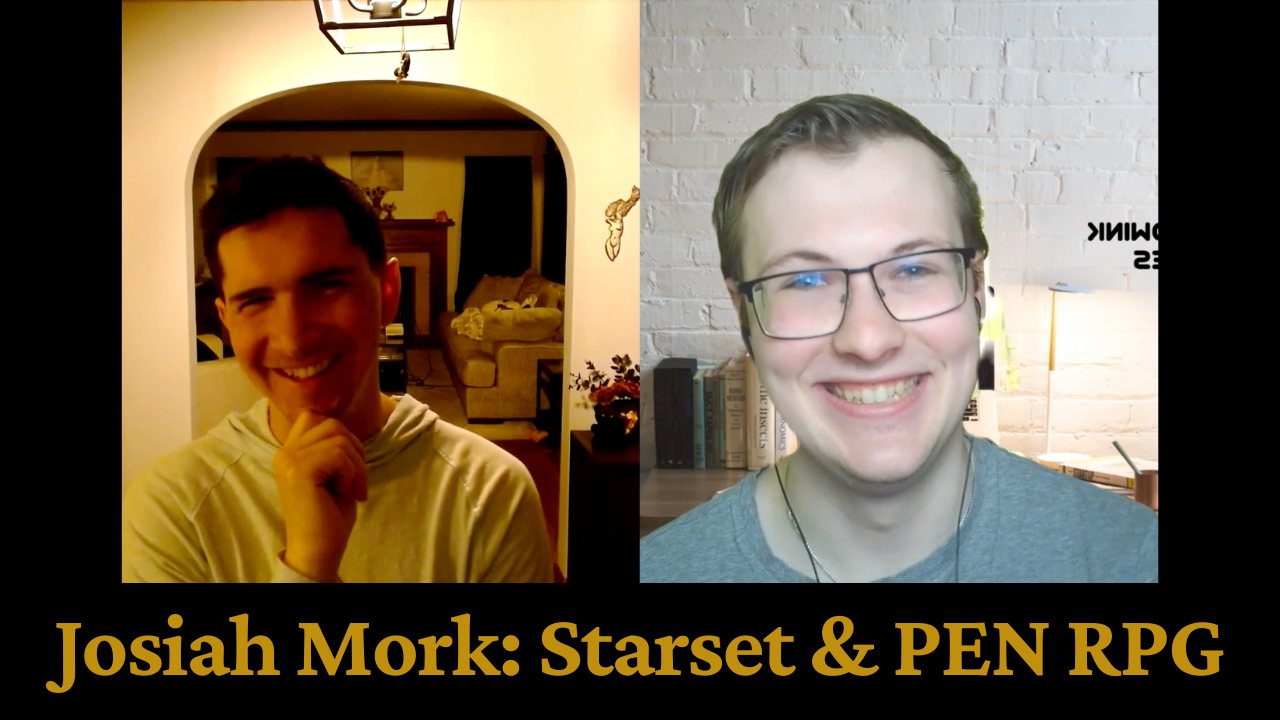
Josiah Mork: Creator of Starset RPG and Pen RPG

Transcribed content from our recent YouTube video: https://www.youtube.com/watch?v=9In5gaz65s8


Transcription

Jacob Tegtman (00:01.848)

Hey everyone, welcome back to Eternity TTRPG, where we cover really everything tabletop gaming related, Dungeons and Dragons.


Now we're finally jumping into some of my favorite topics, which is game design and getting to spend some time with great game designers up and coming, people who are established. And today we're interviewing Josiah Mork, who is the owner and lead designer for Hoodwink Gaming. So welcome to the show. Thanks for being part of the channel.


Josiah (00:33.142)

Thanks, it's my pleasure. Yeah, it's been great working with you on eternity and getting to swap ideas. So I'm really looking forward to being able to talk through some of that process with you.


Jacob Tegtman (00:44.478)

Awesome, Ben. Yeah, I've been looking forward to talking with you. We always have a lot of fun when we catch up. I think this will be a really good conversation. There's so many parts of your mini games that I've wanted to ask you about for really such a long time. And it always felt like we were working on some project or discussing something. But now I have a really good excuse to just nail you down for maybe about an hour-ish and hopefully die.


Josiah (00:50.028)

for sure.


Josiah (01:04.972)

There's always something.


Jacob Tegtman (01:14.352)

dive into what you've been doing and why you've made some of the decisions you've made, which I think are really interesting. I'm sure, yeah. So do you just want to maybe start by introducing yourself more, know, who you are, what you've done, and yeah, where you're going?


Josiah (01:20.968)

Yeah, well, hopefully I've got good answers for you. We'll see.


Josiah (01:32.756)

Yeah, absolutely. yeah, like you said, I'm Josiah. I'm from Michigan, living just out of DC now. I've been designing and playing board games since my early teen years, I guess I would say. I love creative writing and storytelling. That's just been an amazing way that I've found to connect with people.


My actually my undergrad and my grad degrees were in communication and looking at how communication connects us and strategies and stuff behind it. And so I find a storytelling a really compelling way to do that. But before I had gotten into school and whatnot, you know, I was homeschooled. I was in late middle school and I was reading this cartoon. Maybe you are some of your viewers have seen it. Foxtrot comics. And there are some.


Have you seen it? Highly recommend, highly recommend. It's really funny. But there are these two characters, they're really nerdy middle schoolers and they were playing Dungeons and Dragons in the comic. And I just thought that was the coolest thing. But my parents, know, I'm a Christian, my family's Christian, fairly conservative. And so my parents were more familiar with like the 80s, like D &D scare, very like Stranger Things season four.


And so they were not really like, yeah, not really D &D fans. And so I was like, well, okay, I'll create my own. And that's how it all got started, you know? And then it was a great way to make friends in my Boy Scout troop. You know, we would play, would swap ideas, we would...


Jacob Tegtman (02:51.202)

Yeah.


Jacob Tegtman (02:55.042)

Not too far ahead. Sure.


Yeah, that's awesome.


Jacob Tegtman (03:08.12)

time.


Josiah (03:09.972)

you know, go on crazy adventures with rules that didn't quite work. And then over time, you know, I just realized that there were all of these cool avenues to explore and storytelling that D &D didn't necessarily do. And so I just felt really passionate that this is my way to connect with people and connect people with each other is through writing games.


Jacob Tegtman (03:30.508)

That's amazing, man. Yeah, it's funny, like the ways that we get into gaming too. Like you mentioned those comics. you ever see Dexter's Lab? Okay. Okay. Yeah, was probably a little bit before. Yeah. There was like an episode that was kind of based on Dungeons and Dragons and I saw it when I was like six and that's what got me into it as well. yeah.


Josiah (03:39.616)

Yeah, well, I've heard of it. Yeah, I've seen clips from it, yeah.


Josiah (03:52.972)

It's so funny how it seems like every show, know, Community, Gravity Falls, like, there are all these shows of every different genre, and they all have like a D &D episode for some reason. And I love it, you know, but it's so random.


Jacob Tegtman (03:58.679)

Yeah.


Jacob Tegtman (04:05.302)

Yeah, like all of them.


Me too. Yeah, it is. Yeah. I also like the takes that different shows have on like nerdy board games. I think was like Parks and Rec had, I forget what the game was called. Yeah, you remember it. Yeah. Yeah. That's so cool, man.


Josiah (04:20.81)

The Cones of Dunshire, yeah. Love that, love those episodes.


Jacob Tegtman (04:29.646)

So I want to dive into really all of those things more, but what games do you currently have available then? And your website will post it in the show notes as well, but it is hoodwinkgaming.com for anybody who's interested. But yeah, tell us about some of your games. And again, I feel like I want to go into all of these in more detail, but yeah, give us the summary version at least for now.


Josiah (04:55.05)

Yeah, so it's a little deceptive at the moment. My original titles and kind of most of the games that I do are under the pen brand. So play easily now is the acronym. We have war game and role playing game. But actually neither of those are on the market at the moment. If you go to my website. Yeah, we've got a landing page for the war game and we've got a preview for the RPG. And I've actually I've got.


Jacob Tegtman (05:12.95)

really? I was actually, yeah, I was checking it out like yesterday, so.


Josiah (05:24.422)

know, prototypes of both of those here. But they are still in development because of various different reasons of wanting to refine some ideas or just kind of ended up having to move to other projects. So they're almost launch ready. But those are the ones that they're working on for the longest, just the newest editions aren't quite together yet.


Jacob Tegtman (05:29.506)

Yeah.


Jacob Tegtman (05:39.96)

Yeah, nice.


Jacob Tegtman (05:46.04)

Very cool.


Josiah (05:46.164)

And then the one that I've been working on most recently, and that we actually have a new project launching next month for, is Star Set. So that's a grimdark survival-oriented tabletop role-playing game that we launched initially a couple years ago, and then just did a relaunch for the second edition for, which is much more crunchy, much more mechanical, and much more narrative-based. So really looking forward to building that out.


Jacob Tegtman (06:14.542)

That's exciting. Yeah, I can attest that game is great. I really enjoyed reading through it. Everything from the design of the book to the art to the way that you have, especially character building in that, I find super fascinating. You can just tell, yeah, the amount of attention to detail in there is like out of this world. It really feels like you guys...


Josiah (06:27.148)

Well, thank you.


Josiah (06:34.966)

haha


Jacob Tegtman (06:38.478)

You took the lore of the game and you baked it into every part of the game. Whereas I think a lot of games like, you know, we'll talk about D &D later. D &D is like the game that's everything. So it's like if it's in a fantasy book or movie or anything, like we'll just jam it into D &D somehow. And, you know, that kind of has its place, but for building characters and stuff, you know, like you don't, I don't know. It's supposed to be able to fit many different genres and you're


Josiah (06:42.72)

Mm-hmm.


Jacob Tegtman (07:08.612)

I think what's so cool about is that when you're playing Star set you're playing Star set Because from the very first thing you do with your character and their background and their skills even it's all based on the lore of this whole universe so


Josiah (07:19.902)

Mm-hmm. Well, I really appreciate that. mean, that's really the heart behind it when we were working on it is, we had a story that we wanted to tell and really created the universe to tell that story. And one of the things, you know, that I picked up studying communication is that, you know, we are attracted to details. And even if it's details that, we haven't necessarily experienced in our own lives.


Jacob Tegtman (07:24.963)

Yeah.


Jacob Tegtman (07:33.324)

Yeah.


Josiah (07:45.324)

hearing vivid details or strong emotions in other people's stories lead us to be more connected with them. And so that was something that we really trying to flesh out in Star Set. hopefully, from the sound of it, it hopefully worked pretty well.


Jacob Tegtman (08:00.352)

I think so, yeah, absolutely. So, what do we talk about first, man? Like, what do you want to talk about first?


Josiah (08:01.452)

Thank you.


Josiah (08:11.672)

man, I could talk about games for hours and hours, so I better let you guide that conversation.


Jacob Tegtman (08:14.944)

You


Okay, I just want to make sure we cover like the big things before we dive into the nitty gritty here. Yeah. Yeah.


Josiah (08:24.332)

Oh yeah, I mean, I kind of touched on, I guess I'll throw it out there. I'll throw it out there because it's really important to me and kind of the company into my story. you know, I really do, we're about to, you know, dig into the nitty gritty, like you said, and Dungeons and Dragons and all the different games that are out there. And I just think, you know, before whether you're a designer or a player, whenever you kind of step into a game, I think the most important thing and what's in the mission kind of a hoodwink that we try and do differently is that


Jacob Tegtman (08:33.379)

Yeah.


Josiah (08:53.446)

The games are just kind of an excuse. Really, the games are just an excuse to get together with people and to have FaceTime with people. And if working in social media has taught me anything, it's that people need that more than anything. And that's why we call it Hoodwink Games, because we kind of have all these substitutions. get hoodwinked into thinking that socializing is something that it's not. And really, it's just fellowshipping with people and joining community and FaceTime with people.


and talking about the things that matter with people. And the way to do that from going from stranger to best friend is in my experience games. And so that's kind of the heart behind it.


Jacob Tegtman (09:30.658)

That's been a cool one. Yeah.


You know, it's interesting you bring that up too, because this is something I've been thinking a lot about recently, especially as everybody's been seeing more AI come into their work, into their lives. And I feel that more than ever, people are wanting that human, real human interaction. And so as good as video games are looking nowadays and as fun as MMOs are and stuff like that, and I like all of those, I don't think I've


Josiah (09:43.628)

Mm-hmm.


Josiah (09:53.004)

Mm-hmm.


Jacob Tegtman (10:03.53)

found anything that's as fun is sitting around playing a tabletop role-playing game, especially in person. mean, even, you over FaceTime like this is fun, but something in person about it just makes it one of the best experiences.


Josiah (10:09.729)

video.


Josiah (10:13.142)

Mm-hmm.


Josiah (10:18.686)

It really does. It's those shared memories and those shared jokes. And, you know, I work in politics, doing social media for politics. And the thing that just aggravates me the most about politics, but also religion, people say don't talk about politics or religion because people care about it so much. And it's like those are things that we care about the most. So we should be able to share those with people. But you can't because as soon as you bring them up, you know, there are all these walls.


Jacob Tegtman (10:39.48)

Sure.


Josiah (10:48.062)

and games when you've played for a couple hours with somebody and slayed the dragon and made a couple jokes, then it's like, well, okay, now your opinion isn't the thing that I'm defining you on. The thing I'm defining you on is that, you know, you're a half drunk elf paladin or something like, and it just makes it easier.


Jacob Tegtman (10:48.416)

I guess.


Jacob Tegtman (11:04.014)

Yeah, that's so true. That's so true. Yeah, it definitely does break down those walls and give you that sense of shared history, even if it's like a shared mental history, theater of the mind. So, yeah.


Josiah (11:17.27)

Mm-hmm. Mm-hmm. It's great.


Jacob Tegtman (11:21.428)

I agree, man. Especially when you're doing... So I haven't read through all of the lore of Starseq. There's just so much in there. I've read through a good deal of it. But I think one of the things that also stands out about at least that game, because I know Penn's still in the work in progress...


Josiah (11:38.599)

the


Jacob Tegtman (11:39.446)

that, you know, it does cover a lot of political things and it covers a lot of religious things and you aren't like pushing a view on anybody, but just inherent to human life is politics and religion. so games let you approach these topics like in ways that allow you to explore what could be, but in a safe way and have conversations about what could be without feeling like you're being attacked or told.


Josiah (11:53.856)

Mm-hmm.


Josiah (12:01.6)

Thank you.


Josiah (12:05.836)

Mm-hmm.


Yeah, that's really the, again, I'm really glad that you feel that way about the game, because that was one of the number one priorities of it, is there are just really hard conversations that should be had. And that game kind of came out of COVID, where there were a ton of hard conversations people were having. And I think you could spend every day, every minute of every day with people.


Jacob Tegtman (12:14.306)

Yeah, for sure.


Jacob Tegtman (12:23.394)

That's right. That's right. Yeah.


Josiah (12:33.664)

but if they're not people that you feel like you can have hard conversations with, then you haven't really been in community at all. And so having a medium like that, where, like you said, I don't wanna tell anybody what they should believe. There are things that I believe are true about God and about the world and about politics and stuff, but those things have to exist relationally for them to mean anything to you. so...


Jacob Tegtman (12:39.788)

Yeah.


Jacob Tegtman (12:50.542)

Sure.


Josiah (12:58.954)

to have that space to kind of explore and talk and then role play through just makes it fun for one thing, but also makes it so much more personal and so much more impactful, I think.


Jacob Tegtman (12:59.374)

Yeah.


Jacob Tegtman (13:10.772)

I agree. So what is the next thing that you said you're working on with StarCert? I think I missed that when you mentioned earlier. Yeah.


Josiah (13:16.436)

Yeah, so my co-writer, Emily, and her husband Ryan, who did some of the art for Star Set, they have actually written and illustrated the first campaign for it. It's called Echoes on Mars, and that's going to be launching on Kickstarter next month.


Jacob Tegtman (13:31.822)

Okay. Okay, cool. That's exciting, man. So what number of Kickstarter will this be for you?


Josiah (13:38.092)

Thank


Josiah (13:42.294)

That's


Josiah (13:46.806)

seven maybe six or seven. I'm doing this one well I should say the plan is to do it on Kickstarter but changing a lot of things. I'm still talking to them. My wife is behind me. I still want to talk through some of them with her because it had a lot of very negative Kickstarter experiences and learned a lot. So we're to do this one if we end up doing it on Kickstarter very slim down and very different than some of the other ones. So it's a constant learning experience.


Jacob Tegtman (13:48.43)

Sort of. Yeah.


Jacob Tegtman (13:54.094)

Sure.


Jacob Tegtman (14:16.43)

Yeah, I just remember I feel like every year or so I feel like you're launching something on Kickstarter successfully. So at least from the outsider's view looking in, it's like man Josiah just knows what he's doing with selling games.


Josiah (14:30.208)

You


Well, I know a little bit more than I did last time and that's the goal. Yeah.


Share This Article

Jacob Tegtman Eternity TTRPG Creator

Author - Jacob Tegtman

Dear reader, I hope you enjoyed this article. Tabletop gaming has been a passion of mine since I was 6 years old. I've played just about every game from Dungeons and Dragons to video games like Final Fantasy. These games have inspired me, made me laugh, made me cry, and brought me endless hours of enjoyment.


I started Eternity TTRPG - and the indie tabletop game that goes along with it (Eternity Shop) - to share my love of gaming with others. I believe that in our technology-driven age, tabletop games help bring a sense of magic and community back into our world.


If you love the site, please share it with others! I have lots of gaming-related material for you to peruse and use in your own gaming sessions. If you have any questions about the site or want to contribute, just send me a message using the "Contact" page, which you can find in the site's footer.
Rethinking D&D Design Conversations
By Jacob Tegtman May 5, 2026
Transcribed content from our recent YouTube video: https://www.youtube.com/watch?v=T2pHaAcKDbo Transcription [00:00:00] I want to start talking more about Dungeons Dragons and game design So far on this channel it's really been a news style kind of coverage where new things are happening new books are releasing and so forth But one of the things I've experienced and probably a lot of other people have as well is that Dungeons Dragons hasn't really improved as a game over the last many editions I started playing Dungeons Dragons at 3.5e Many of you probably were around the same time Maybe there's a lot of 5e players originals out there or there's you know basic or advanced Dungeons Dragons players I love Dungeons Dragons It was my introduction to the TTRPG hobby and TTRPGs are one of the main pillars of my life in a way I've spent most of my life making games creating supplemental [00:01:00] material for Dungeons Dragons exploring some of the lesser-known TTRPGs the indie games and trying to understand why I love it so much and then bring that joy to as many people as possible in as many ways as possible I think there's a lot of ways to play this hobby But one of the disappointing things to me is that D&D 3.5 compared to say 5.5e now is there's still a lot of things I prefer in 3.5 And as I've learned about basic and advanced D&D there's a lot of things I prefer even in those games So if you're not getting what you really want out of Dungeons Dragons this is kind of the direction I wanna take things I still love D&D This channel isn't gonna become about roasting D&D or even necessarily going to a ton of other TTRPGs and reviewing them And I mean there's a million other games out there you can try and a lot of them are great Pathfinder Daggerheart I've reviewed a [00:02:00] lot of them on the Eternity website But what I wanna do is present some of the ideas that myself as a game designer I've come up with over the last Well I I've probably been designing or editing games since I was about six Uh I think I was 12 when I first made a map where people could play through and you know actually engage in a a full-fledged game that I made So Let's say twenty-four years of game design experience for myself I'm a at this point a hobbyist so I'm not a professional I've never worked for Wizards of the Coast or any other publishing company I have published my own TTRPG and I'll be sharing that more in the future But all of that aside I wanna start talking about in this channel still some of the news things that are coming out but I wanna share it from the framework of here's maybe how you can take this and make it better There's a lot of elements in [00:03:00] D&D that I wanna be talking about that I think are cool but we could make a lot better So some of those topics number one being initiative I think initiative is very uninspired There's nothing wrong with it right Like the initiative system for D&D gives you everything you need to play a combat encounter It's very simple You roll a d20 you add your modifiers If you have like the alert feat in 5E Then you get to go faster and going faster typically means that you're gonna get like one extra turn than a lot of your other friends at the table or enemies that you're facing Because say you're you're seven rounds in you're taking your seventh turn they've only had six but then all the enemies are dead um that's kind of the the value of initiative right Like so going first does matter but it's not that exciting is it Like you just roll you add your bonus and then you're locked in like a static initiative for the rest of the battle [00:04:00] And these kind of issues with D&D lead to very stagnant situations where people take their turn and then they pull out their phone and they know that it doesn't really matter if they're engaged at the table because for the next five ten fifteen minutes going around the table for everybody to take their turn depending on how well the dungeon master runs a combat encounter they could have literally nothing to do especially if they don't have any reactions so forth So you kinda see this with initiative number one You see this w even with basic things like hit chance and these kinda tie in a lot because players will roll saves when it's not their turn and it gives them sort of something to do at least But with AC it's just a static value it's a situation where the dungeon master may not even need the player because a lot of DMs they write down their player's AC Before the battle even starts So they know when they're rolling behind their uh little table or you know whatever however they [00:05:00] use it maybe as a DM you're just rolling out in the open so anybody can see the D20 Other people hide that number but if they roll a five and the monster's got a plus ten or whatever they just know that they hit somebody who has a fourteen or lower right So they don't even really need the player You just Dungeon Master rolls you take X amount of damage and then all the player has to do is record that on their character sheet then they can get back to their iPhone right Like that's lame There's a lot of situations like this that could be improved I also think it's really interesting looking at old school D&D and other [00:06:00] channels talk about this kind of thing a lot and I think it's something that we could bring back to modern D&D with very good results would be things like the dungeon turn or random assigning of how enemies or NPCs feel towards the party I don't think that the critical role way of playing D&D the the theatrical way of playing D&D is necessarily the best way of playing D&D And I don't have anything against that I really like narrative gameplay A lot of the dungeons um a lot of the campaigns that I have dungeon mastered for have been fairly narratively driven And I really like I I've never written a novel but I like writing the the campaign style novels and then being free to adjust that as my players make decisions But I also think it it isn't necessarily the best way sometimes I've [00:07:00] been very inspired as a dungeon master and I've come up with great narrative plots that my players are super into and it makes for an amazing twenty-five to thirty-five session campaign over the course of a year year and a half that people love and we still talk about And there's been a lot of times as well where I'm not very inspired but I'm still trying to rely on those kind of plot points that older styles of D&D don't make you use because they generate a lot of that for you Emergent storytelling is the term I'm looking for where you don't necessarily know what plot is going to come out of the story but sometimes that's much better because at those moments in my own campaign creating where I haven't been the most inspired those campaigns can die really easily Those are the campaigns that last anywhere from two to seven sessions and just like you often hear about most campaigns die after seven sessions Those are the ones that don't make it [00:08:00] So I think that there are a lot of great older ideas that for some reason the newer versions of Dungeons Dragons didn't bring forward I also think that D&D being a fairly old game and don't get me wrong I love older games I play them all the time but it's surprising the lack of innovation I think that has been in the industry over the past What I mean when did D&D come out I Is it I can't think off the top of my head Is it forty fifty years I'm surprised there isn't better stuff Um and don't get me wrong I I love the other games too I love Pathfinder I love Daggerheart I think they're all cool but I think we can do better And so I'm not necessarily saying I have all the ideas for what could make it better but over my twenty years of designing games twenty plus I've come up with some very simple ideas that I wanna share with you and I think that when you try them out for yourself give me some feedback let me know what you think um I think together we can come up with something that is [00:09:00] substantially better And so that's my goal Everything from the mechanics of initiative in combat to the way campaigns develop narratively to player agency to things like allowing dungeon masters to also play characters in their own campaigns within limited scopes perhaps sharing the roles of dungeon master I think there's a lot of things that we could do to actually truly advance the TTRPG hobby genre beyond what we've seen so far So that's the direction that I plan to take with the channel moving forward I'm looking forward to some of these first videos We're gonna talk about the initiative system We're gonna talk about the hit chance system and I can't wait to get your feedback on it But hopefully this is a turn for me away from just new style stuff and towards stuff that you can use in your campaigns  [00:10:00] like tomorrow And I hope that you enjoy it and I hope to hear from you on topics that you want to see improved in your own D&D games And again I think together we can come up with some truly amazing improvements So until next time talk to you then.
“New Path of the Lich”
By Jacob Tegtman April 29, 2026
Transcribed content from our recent YouTube video: https://www.youtube.com/watch?v=an8LlwVXGns Transcription Becoming a lich in D&D has – usually – been something reserved for villains. But in one of the latest Unearthed Arcana from early April, that line gets a little blurrier.  Really cool way that they approached this: there’s now a feat-based system that allows players to work toward lichdom for their characters, over time. So today, we’re going to walk through what becoming a Lich officially looks like—and whether it’s something you’d realistically use in a campaign. Because... you know... with the new D&D seasons releases, and Spring time being about the “horror genre,” nothing says “become a lich” like green trees and budding flowers. So, here we are! Welcome back to Eternity TTRPG—your go-to place for Dungeons & Dragons content, news, games, and updates. Today we’re looking at the Path of the Lich from the new Villainous Options playtest. To understand the system, it helps to start with the lore. A lich in D&D is a spellcaster who avoids death by binding their soul to an object—commonly called a phylactery, or in this case, a spirit jar. The process is intentionally grim. It involves creating that phylactery vessel, performing a ritual, and effectively dying—only to return as an undead being sustained by magic. Mechanically and narratively, liches are defined by two things: Their detachment from mortality And their dependence on that external object . Kind of like a horcrux, from Harry Potter. That phylactery is what makes a Lich difficult to destroy, and why they’ve historically been used as long-term antagonists, such as during one of my personal favorite adventures of all times: the original Tomb of Horrors. The Path of the Lich is part of a broader Unearthed Arcana release focused on “villainous” character options. Instead of a subclass, as a very interesting take on things, this is structured as a sequence of feats. Keeping the Lich path separate from any class means that no matter what you play as, you can make a Lich out of it! This means that your fighter, for example, could be a Lich, or your rogue (not that you’d ever play a rogue), and you can have that “undead character” without tying yourself to the traditional “Lich-as-a-spellcaster” archetype. The Lich progression looks like this: You begin by defining a Lich Rite , at any level, which is mostly narrative At level 4, you take Lich Initiate Between levels 5 and 11, you select at least one additional related feat, from the options of arcane restoration, transfer life, or undead grasp And then at level 12 or higher, you take Lich Ascension , to officially become a Lich So rather than a single transformation, your character goes through a gradual shift in both mechanics and tone, which is very based in D&D lore. The Lich Rite feat is worth discussing in some detail, even though it doesn’t have strict mechanical weight. This first feat in the Lich chain sets the narrative expectation for becoming a full-blown Lich, by providing the character with a sort of quest they must first complete, such as: Consuming a large number of souls Using magic to conceal yourself from the gods of death Brewing potions from slain foes Or severing your connection to any afterlife, entirely These aren’t small story beats. They really do imply a campaign where moral boundaries are actively being crossed—or at the very least, being questioned. So, before mechanics even come into play, there’s already a conversation to have at the table. Next, is the Lich Initiate feat. This is the foundation. You create your spirit jar , which functions as your anchor, the basis for your phylactery. You also gain Soul Siphon , allowing you to consume the soul of a defeated humanoid for a small damage boost. There’s also a risk component—if your spirit jar is destroyed, you suffer penalties until it’s replaced. You then choose how to build on your lich path with a third feat that improves soul siphon: Arcane Restoration lets you convert soul siphon uses into spell slot recovery Transfer Life turns soul siphon uses into temporary hit point bonuses for allies Undead Grasp adds a control option through paralysis These are fairly modular feats. They don’t radically change your role, such as by forcing you into becoming a full-fledged Lich spell caster, but they do add magical efficiency and utility depending on your build. Finally, at level 12, the transformation to Lichdom completes. You: Become Undead Gain resistance to necrotic and poison damage Get access to Fear without expending spell slots And gain a form of rejuvenation tied to your spirit jar That last point is the most significant mechanically. It introduces a conditional form of returning after death, assuming your phylactery remains intact. So, is the Path of the Lich actually worth taking? Mechanically, it’s solid. You’re getting: Incremental power increases Some resource flexibility And a strong late-game feature tied to survival But the bigger consideration isn’t mechanical—it’s contextual. This kind of progression assumes: A campaign that supports darker character arcs A group that’s comfortable with those themes And a DM willing to integrate the consequences of these morally very-dark-gray life choices In a more traditional heroic campaign, it may not fit at all. The path of the Lich feels less like a standard player option, and more like a tool for specific types of stories. If used carefully, it could support a long-term character arc focused on ambition, cost, and transformation. It allows players to experience some really interesting game mechanics that have long been reserved mainly for monsters or main campaign villains. If this feat path is used casually, it does risk feeling out of place—or undercutting the tone of the game. And let’s just remember, since it’s still Unearthed Arcana, parts of this entire path are also likely to change based on feedback. So the real question is: are you going to play a lich in your next campaign? Or do you think lichdom works better as something players confront… rather than become? Let me know in the comments. And if you want more D&D news and breakdowns like this, consider liking and subscribing. Thanks for watching!
“New Dark D&D Subclasses: for Bard, Druid, & Warlock” Blog
By Jacob Tegtman April 28, 2026
Transcribed content from our recent YouTube video: https://www.youtube.com/watch?v=k_DQ3rc0Xes Transcription Wizards of the Coast has released three new subclasses in their latest Unearthed Arcana, focusing on darker themes like death magic and corruption mechanics. They’re free to access and already generating a lot of discussion in the community. Welcome back to Eternity TTRPG—your go-to source for D&D and tabletop RPG news. Let’s take a look at what’s included in this latest release, and how these classes might fit into your game. If you aren’t familiar, Unearthed Arcana is Wizards of the Coast’s official playtest material, where new subclasses, rules, or mechanics are released for public feedback before possible full publication. New Unearthed Arcana releases don’t follow a strict schedule of new subclass releases, but they tend to appear a few times a year depending on development cycles. There’s also no fixed order for which classes get new subclasses—design choices are usually driven by current design goals, themes, or upcoming products rather than a rotation system. This could in part be driven by the “D&D Seasons” that we’re now seeing from Wizards of the Coast with their planned product release schedule, this year. Getting right into things though, the subclasses this round are: College of Mourning (Bard) Circle of the Primeval (Druid) A revised Fiend Patron (Warlock) The College of Mourning focuses on death-related magic. Instead of traditional inspiration, it blends necrotic damage with support abilities, allowing bards to deal damage while also healing allies. Community reactions have noted the strong thematic direction. One Reddit user described it as a good fit for darker character concepts, though some DMs may need to consider how it fits their campaign tone. Mechanically, early impressions suggest it’s relatively balanced, with its healing and damage requiring positioning and timing. The Circle of the Primeval explores a more ancient and unfamiliar side of nature. Instead of typical beasts, their Wild Shape options include more unusual, sometimes unsettling forms—drawing on prehistoric or aberrant inspirations. At 6th level, their “Primordial Awakening” feature allows additional effects like resistance to psychic damage and abilities that can disrupt enemies mentally. Some players like the new, darker style of this subclass as a change of pace, while others worry it might not fit the tone or gameplay balance of more classic, heroic D&D campaigns. This subclass may work best in settings where the implied, dark themes of the subclass are already established and agreed upon by the group. The updated Fiend Patron introduces a more structured approach to corruption mechanics. The new “Infernal Bargain” system allows warlocks to gain temporary power in exchange for accumulating “Corruption Points.” As corruption points increase, characters gain benefits—but also drawbacks, including possible DM influence over certain decisions at higher levels. To be clear, Corruption Points are gained each time the warlock uses their Infernal Bargain feature to gain their temporary power increases. This system has sparked discussion around player agency. Some players appreciate the mechanical representation of risk and consequence, while others are cautious about how it might be implemented at the table. Overall, it adds a clearer framework for storytelling, but likely requires strong communication between players and DMs. Community discussion around these subclasses has been active, particularly among DMs considering how to integrate them. Some concerns focus on tone—especially in campaigns that already have a defined setting or theme. Others are more mechanical, particularly around balance and player agency. Wizards of the Coast has included guidance in the document, including suggestions for implementation and reminders to use session zero discussions and safety tools when introducing darker themes. If you’d like to play these subclasses at your table, You can download and learn more about them for free on D&D Beyond or through official Wizards of the Coast Unearthed Arcana posts. I’ll include links in this video’s notes, below. Quick episode today, but that about wraps things up! So, what are your thoughts on these new subclasses? Would you include them in your campaign, or do they feel too specific in tone? Let me know in the comments. And if you enjoyed this breakdown, consider liking the video and subscribing for more weekly D&D news. Until next time my friends—keep rolling those 20’s.
Show More