DragonLance Legends coming to Amazon in February
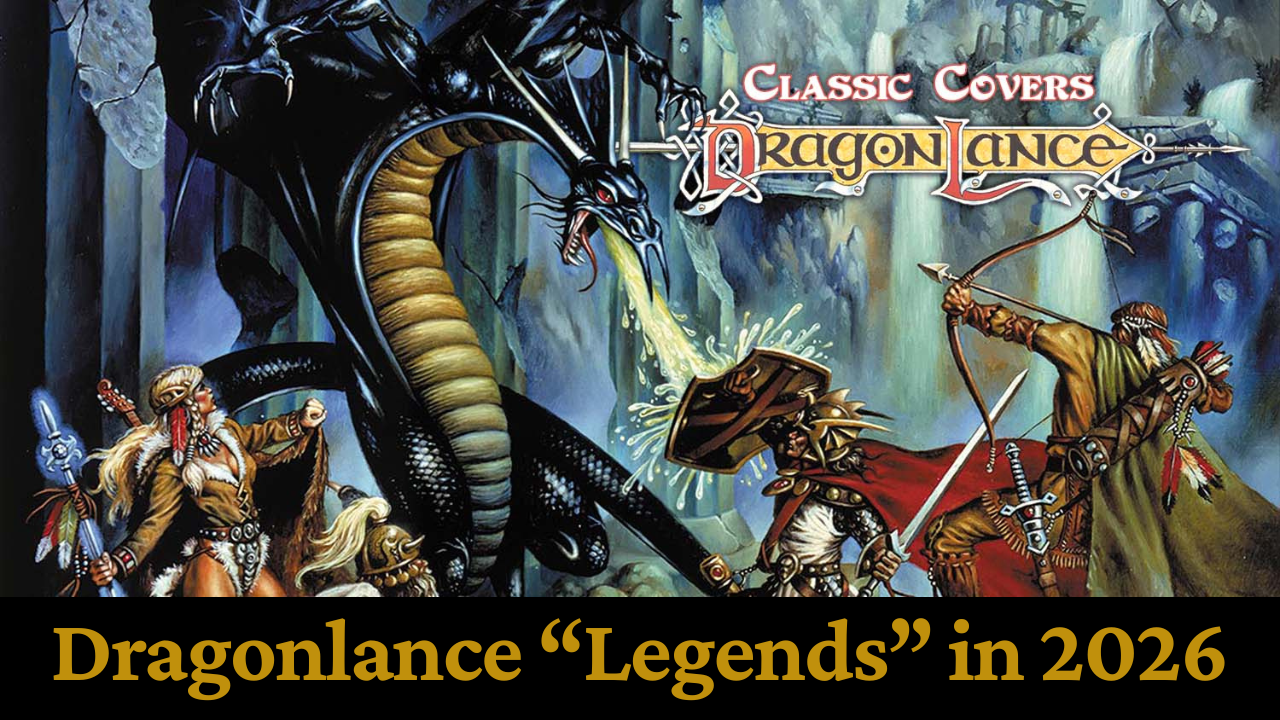
Transcribed content from our recent YouTube video: https://www.youtube.com/watch?v=257fKzW8yzA
Transcription
Before there was Game of Thrones, Baldur’s Gate, and Critical Role.… there was Dragonlance.
A fantasy saga that defined an entire generation of D&D players — epic wars, tragic heroes, and dragons that actually felt like dragons. But if you aren’t familiar, what is Dragonlance — and why are we still talking about it in 2026?
Well to answer that last question, the new “Legends Edition” which is the second Trilogy of Dragonlance is coming to Amazon in February. This is a big deal because getting new copies of the original Dragonlance Chronicles Trilogy, and now this second “Legends” Trilogy was becoming very difficult.
I’m hoping these new prints rekindle the spark of one of the greatest D&D settings and novel series of all time, and introduce even more people to its magic.
Welcome back to Eternity TTRPG, your home for D&D history, lore deep-dives, and the stories that shaped the game we play today.
If you love tabletop RPGs, classic settings, and learning why D&D looks and plays the way it does today, you’re in the right place.
So, let’s talk about one of my favorite fantasy settings – and fantasy book series of all times – Dragonlance.
Dragonlance started as a bold idea from Tracy Hickman and Laura Hickman, later developed with Margaret Weis at TSR. To answer the burning question you may be having, right off the bat – yes, the Dragonlance adventures came before the book series.
At the time, most D&D adventures were simple and modular. You’d kick in a dungeon door, fight some monsters, grab treasure, and move on. Dragonlance asked a very different question.
What if Dungeons & Dragons could tell one long, epic story?
Instead of disconnected adventures, the Dragonlance team wanted a campaign with a clear beginning, middle, and end. A single, continent-spanning war. A story that unfolded over time, not just session to session.
To make that work, players wouldn’t create random characters. They’d play pre-generated heroes, each designed to fit directly into the narrative, with personal arcs baked into the plot.
That idea became the original Dragonlance AD&D module series — eventually twelve linked adventures telling the story of the War of the Lance.
On paper, it was revolutionary. At the table… it was complicated.
The problem is simple. And honestly, you can probably pause the video here and tell me the problem, yourself, based on your own D&D games. It’s basically this: D&D games, and it’s players – are unpredictable.
Dungeons & Dragons thrives on player choice, improvisation, and chaos. Dragonlance, on the other hand, needed players to be in very specific places, doing very specific things, at specific times.
If the party ignored a hook, skipped a location, or made an unexpected choice, the entire story could fall apart.
So the modules relied heavily on railroading — nudging, and sometimes outright forcing, players back onto the intended path.
That tension made Dragonlance awkward to run as a campaign. The story was strong, but the format worked against the strengths of tabletop roleplaying.
And that’s when Dragonlance found the form it was truly built for.
To promote the modules, TSR (that is, the company founded by Gary Gygax and Don Kaye, to publish D&D) decided to release a trilogy of tie-in novels.
That decision came late, the original author didn’t work out, and Margaret Weis and Tracy Hickman ended up writing the first book themselves — in roughly three months.
The result was Dragons of Autumn Twilight, released in 1984. Which, even talking about almost brings a tear to my eye – the book was just that impactful to me in my teenage years.
TSR expected modest sales. But instead, the book was a massive hit.
For many readers, this wasn’t just their first Dragonlance novel — it was their first D&D novel. It introduced the idea that a D&D party could be the heart of a fantasy epic, with flawed characters, emotional arcs, and long-term consequences.
This is basically why Dragonlance matters to D&D history. And not just a little bit. It matters – a LOT. Dragonlance proved that Dungeons & Dragons wasn’t just a game system — it was actually its own entire storytelling engine.
If you haven’t read the novel series, I have some amazing news for you, shortly. But at its core, Dragonlance is about one idea: hope in darkness.
The world of Krynn is broken. The gods are distant. War is everywhere. People are scared, tired, and cynical. But, the world of Dragonlance isn’t saved by a single chosen hero. Instead, this novel series tells you that the world can be saved when ordinary people choose to do the right thing, even when it’s hard, and even when it feels pointless.
That philosophy shaped the tone of the setting. Dragonlance was darker than most TSR-era worlds, but it was never hopeless.
Friendship mattered. Faith mattered. Sacrifice mattered. Umm, a lot.
Those themes became incredibly influential, especially for party-focused storytelling in D&D campaigns.
Dragonlance also changed how dragons were treated in D&D.
Before this, dragons were often just very powerful monsters. Dangerous, sure — but still just another encounter. Dragonlance made dragons rare, mythical, and world-shaping.
What becomes the mystical return of dragons isn’t just a side quest in this setting. It’s THE central event that changes the balance of power across the entire world.
That idea — that dragons should feel legendary, and not just routine — stuck, and it still shapes how dragons are presented in modern D&D.
After the success of the original trilogy, Weis and Hickman followed it with Dragonlance Legends, which is what I’ll be getting to more about in just a few minutes.
Instead of escalating to an even bigger war, Legends zoomed in. It focused on the twins from the first trilogy: Raistlin and Caramon Majere, and on the topics of ambition, responsibility, and the cost of power.
It introduced time travel – which to be honest, I don’t love – personal tragedy, and consequences that felt intimate. This trilogy, too, was a massive success, even hitting the New York Times bestseller list — a first for TSR.
For a brief moment, Dragonlance wasn’t just a D&D setting. It actually became the face of D&D storytelling.
But Dragonlance’s greatest strength eventually became its weakness.
The setting was tightly bound to one story and one cast of characters. Once the War of the Lance was resolved, the world of Krynn felt… finished.
New stories struggled to find the same weight. Bigger threats felt repetitive. New heroes had a hard time stepping out of the shadow of the originals.
Unlike the Forgotten Realms, Krynn never felt like a neutral playground. It felt like a world where the most important story had already happened. And slowly, Dragonlance faded from the spotlight.
Dragonlance went quiet after 2010.
But in February 2026, we’re getting a new hardcover release of Dragonlance Legends — collecting the full trilogy with new behind-the-scenes material from Weis and Hickman.
It’s not a full revival of the setting. It’s a reminder of an important moment in D&D history, when the game experimented with storytelling in a way that permanently changed how we think about campaigns.
This trilogy about the twins: Raistlin and Caramon – is coming after the Chronicles trilogy was rereleased (I believe) just this last year – I got my copy from Margaret Weis at GenCon.
These books haven’t been in print for some time. So, if you like what you’ve been hearing about Dragonlance, or you – like me – are a longtime fan, you may want to pick these up.
You can get the original Chronicles Trilogy on Amazon now, and the second Trilogy – Legends – is coming out this February.
Dragonlance asked a question that D&D is still trying to answer: Is this game about total freedom… or about telling powerful stories?
Most tables today try to balance both. And whether you loved Dragonlance or bounced hard off its railroads, its influence is still baked into how D&D is played, written, and remembered.
So I want to know — have you read Dragonlance, or played in a campaign set in Krynn?
Would you run a Dragonlance campaign today, or does it feel too tied to its story?
Let me know in the comments, like the video if you enjoyed it,subscribe for more D&D deep dives, and I’ll see you next time.
Dice, Dungeons, Games & More - Eternity TTRPG


Share This Article

Author - Jacob Tegtman
Dear reader, I hope you enjoyed this article. Tabletop gaming has been a passion of mine since I was 6 years old. I've played just about every game from Dungeons and Dragons to video games like Final Fantasy. These games have inspired me, made me laugh, made me cry, and brought me endless hours of enjoyment.
I started Eternity TTRPG - and the indie tabletop game that goes along with it (Eternity Shop) - to share my love of gaming with others. I believe that in our technology-driven age, tabletop games help bring a sense of magic and community back into our world.
If you love the site, please share it with others! I have lots of gaming-related material for you to peruse and use in your own gaming sessions. If you have any questions about the site or want to contribute, just send me a message using the "Contact" page, which you can find in the site's footer.