D&D is Now Officially called D&D 5.5e - No more One Dnd or Dnd 2024
D&D is Now Officially called D&D 5.5e

Transcribed content from our recent YouTube video: https://www.youtube.com/watch?v=9vE0niUm8vU


Transcription

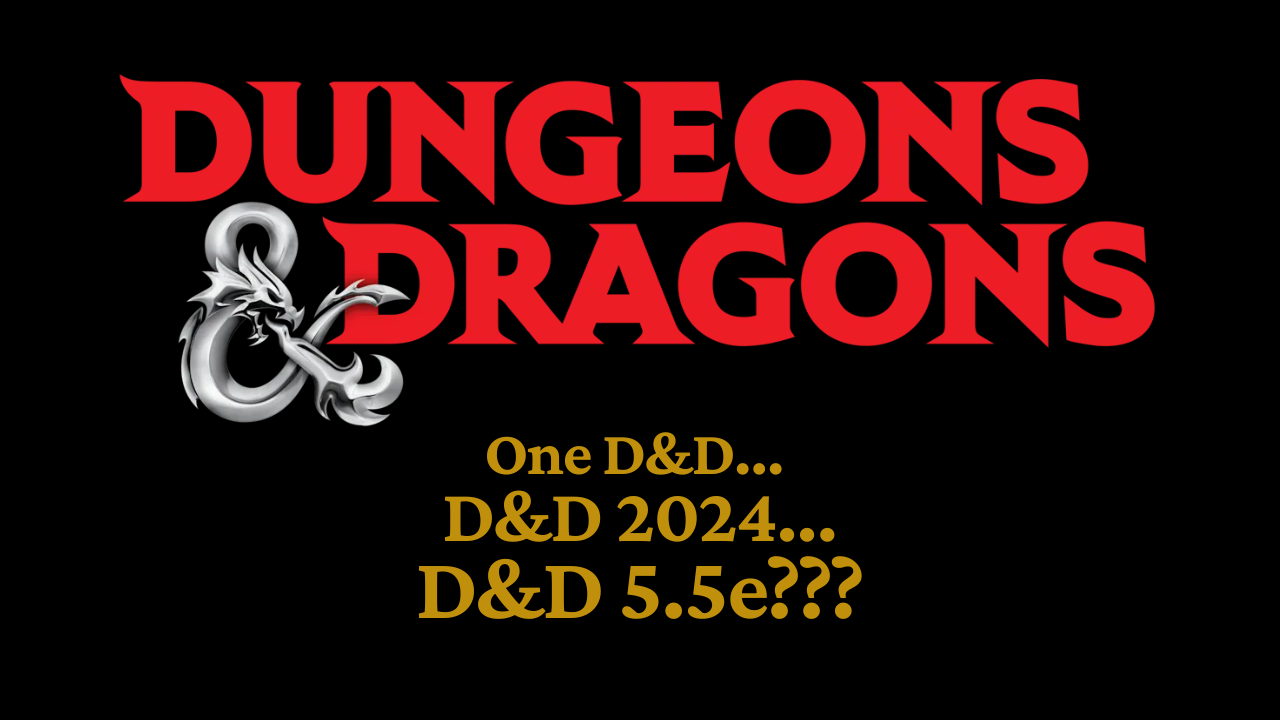
Wizards of the Coast has finally done it. After years of calling it “One D&D(?)”… then “D&D 2024”… and pretending it wasn’t a new edition, while kind of also insisting that it was…


They’ve now officially named it what I had assumed the community at-large has been referring to it as now for probably at least a year, which is:

D&D 5.5e.


Was this the right call? Did, in fact, the community already decide this for them? And does this mean we’ve now officially entered into an edition war era again?


Let’s talk about it.


Welcome back to Eternity TTRPG — your go-to source for all things Dungeons & Dragons.


Today we’re breaking down Wizards of the Coast’s official confirmation that the latest, 2024 rules update is now officially known as D&D 5.5e, what it means for the community, and whether this name change actually does anything.


So, after years of brand confusion, Wizards of the Coast has indeed officially confirmed via a detailed FAQ that the 2024 rules update will now be called:

Dungeons & Dragons 5.5 Edition.


On D&D Beyond, all 2024 material will carry a “5.5e” tag, while legacy 2014 content will simply remain labeled “5e.”


According to the FAQ, the reasoning is simple:

Players mixing 2014 and 2024 content were confused about which rules applied. Which, yeah. No kidding.


And honestly? If you’ve ever tried building a character using mixed subclasses, spells, and feats… you know that confusion is real.

For years this thing – this edition – has had an identity crisis. First it was called One D&D — for some reason – positioned as “the future of D&D.” Then marketing shifted heavily toward “D&D 2024.”


And now?


We’re back to the old-school edition numbering convention.


Wizards of the Coast says using “5e” and “5.5e” makes it quicker and easier to tell what rules you’re using — especially on digital platforms. Which, I agree. I actually got my start into D&D during the 3.5e era, so nothing crazy there for my generation.


From a UX standpoint I think this also makes sense, especially as D&D continues to push their online gaming and presence. D&D Beyond has kind of always been a bit of a mess, to be honest. So any naming convention upgrade to simplify is kind of a win in itself.

But here’s where it gets interesting…


Wizards claims that “5.5e” matches how the community already talks about the game. But, to my surprise, it turns out the data tells a slightly different story.


According to Google Keyword Planner data (March 2, 2026) — filtered across the US, Canada, UK, and Australia — here’s how the search terms stack up:

  • “dnd 2024” – 6,600 monthly searches (+50% Year over year growth)
  • “dnd 5.5e” – 1,300 monthly searches (+19% Year over year growth)
  • “dnd 5.5” – 1,000 monthly searches
  • “d&d 5.5e” – 140 monthly searches


So while “5.5e” and its variant search options is growing…


“D&D 2024” absolutely dominates search volume — almost 2.5x higher, and growing substantially faster, it turns out.


Now, that doesn’t mean 5.5e won’t become standard over time. Especially with this “official switch,” it will. But this is an interesting choice since – this admittedly limited data, shows – that people were perhaps by-and-large finally beginning to actually adopt the “D&D 2024” title.


So, I don’t think I’ve ever mentioned this on the channel, but my main profession is marketing. One small thing that immediately comes to mind is social media hashtags. You can’t use a period in hashtags.


That means:

#dnd5.5e – that’s out


So is it #dnd55e then (?)


#dnd2024, however, totally fine


All this to say is that from a modern branding and searchability standpoint, “D&D 2024” is cleaner. It’s more searchable. More social friendly. Maybe a little easier to type.


So this decision feels less like a marketing move… and more like a database clarity move. This is about tagging systems. Cataloging. Digital sorting.


I think D&D is still having a bit of an identity crisis, basically.


And with all this, here’s the bigger philosophical question.


If it’s called 5.5e… Does that mean it’s officially a half-edition? Historically, we’ve seen this before.

Like I’ve referred to a couple times already, Wizards of the Coast released 3.5e back in 2003 — and that absolutely felt like a mechanical overhaul.


But 5.5e? Is... more like a systemic refinement. Core math remains largely intact. Bounded accuracy is still king. Monsters hit differently, classes are tuned, spells adjusted… But I’m not sure I’d say it’s such a huge departure from 5e, like perhaps 3.5e was from 3e.


The community sentiment is mixed. Some players are relieved there’s finally more clarity. Others feel like the branding mess could have been avoided entirely, and I certainly agree with that.


And then there’s the group that’s been calling it 5.5e for two years going, saying: “I told you so.”


Ultimately though? The name doesn’t change the gameplay. By most metrics, the 2024 rules have been widely adopted and actively played. Which means whether you call it:

  • 5.5e
  • 5e 2024
  • One D&D
  • Or “The Patch Update”


The dice still roll the same.


This move feels like an administrative correction. Maybe it’s helpful for clarity, but isn’t really what D&D needs to move forward right now after all of the mixed feelings people have had about D&D, Wizards, and Hasbro.


Wizards of the Coast is aligning the digital ecosystem with how people track rules versions internally. Will 5.5e stick? Probably.

Will people still Google “D&D 2024” for years to come? Absolutely. You know they will.


But at the end of the day… A game by any other name still crits on a 20.


So, what are you calling 5.5e at your table?


Thanks for watching today! If you want more weekly D&D news, rule updates, and community deep dives — make sure you like, subscribe, and ring the bell.


Otherwise, I’ll see you next session.

Share This Article

Jacob Tegtman Eternity TTRPG Creator

Author - Jacob Tegtman

Dear reader, I hope you enjoyed this article. Tabletop gaming has been a passion of mine since I was 6 years old. I've played just about every game from Dungeons and Dragons to video games like Final Fantasy. These games have inspired me, made me laugh, made me cry, and brought me endless hours of enjoyment.


I started Eternity TTRPG - and the indie tabletop game that goes along with it (Eternity Shop) - to share my love of gaming with others. I believe that in our technology-driven age, tabletop games help bring a sense of magic and community back into our world.


If you love the site, please share it with others! I have lots of gaming-related material for you to peruse and use in your own gaming sessions. If you have any questions about the site or want to contribute, just send me a message using the "Contact" page, which you can find in the site's footer.
D&D book cover: adventurers face a huge monster with a snowy-white head. Emerald and blue hues create a forest scene.
By Jacob Tegtman March 1, 2026
Transcribed content from our recent YouTube video: https://www.youtube.com/watch?v=BvU0p3UMOiU Transcription What if I told you there’s a brand-new D&D book…  where your party is supposed to die? Not “might.” Not “if you roll badly.” But guaranteed total party annihilation. And now it’s officially on D&D Beyond . Today we’re diving into Faster, Purple Worm! Everybody Dies, Vol. 1 — the adventure anthology where death isn’t a failure… it’s the feature. Let’s talk about what’s inside, what’s new, and whether this is actually one of the best low-level chaos tools of 2026. It’s been a minute guys, but welcome back to Eternity TTRPG, your go-to source for all things Dungeons & Dragons — from rule shakeups to purple worm-sized chaos. Last summer, third-party RPG publisher Beadle & Grimm’s released something… deeply unhinged. A 138-page anthology. 15 one-shot adventures. All for level 1 characters. All playable in 1–2 hours. And every single one ends in a Total Party Kill. Not “balanced.” Not “scalable.” Not “talk it out with the villain.” Just. Dead. The book ties directly into the actual play series Faster, Purple Worm! Kill! Kill! , which features celebrity players like Deborah Ann Woll , Seth Green , Anjali Bhimani , and co-founder Matthew Lillard . The whole concept? Lean into the absurdity of low-level adventurers making catastrophically bad decisions… and go full cinematic disaster mode. And honestly? That’s kind of genius. Because most tables never actually experience a true TPK. And this book says, “Cool. Let’s make that the entire point.” So what’s new now that it’s on D&D Beyond ? Mechanically? Same 15 adventures. But digitally? It’s juiced up. You get: 11 Quickplay Maps integrated into the Maps VTT 25 monster stat blocks (9 brand-new creatures + 16 variants) 17 new magic items ready to drop into character sheets 8 shareable handouts That’s actually pretty solid integration. And here’s the real surprise… The price. On D&D Beyond? $19.99. Compare that to: $45 for print $25 for PDF $50 for bundle That’s… unusually reasonable. For D&D... to be honest. Which is not something we say often about digital toolsets. Content-wise, it also leans into classic D&D chaos — including trips to Strahd von Zarovich in Barovia , and even tangling with the beholder crime lord Xanathar . Level 1 characters. Against that. You already know how that ends. If you’re newer to the scene, Beadle & Grimm is known for their ultra-premium boxed editions of official 5E books. We’re talking: Physical handouts In-world props Encounter cards Massive maps High-end collector-tier stuff. Founded in 2018 by Matthew Lillard and partners, they built a reputation on premium experiences. But this anthology? This is original content. Not just luxury packaging. And that’s interesting. Because it signals something bigger: Third-party publishers integrating more directly into official digital ecosystems. That’s a big deal. Here’s why this isn’t just a novelty book. It’s low-commitment D&D. Perfect for new players. It reframes failure as entertainment. Which is actually very healthy for the hobby. We can all take a solid step away from min-maxing, and pretending like we all need to be “good” at our favorite hobby, which to me is often besides the point of “having fun.” Three - It gives DMs a safe sandbox for chaos. Ever wanted to: Drop a meteor? Let the villain monologue uninterrupted? Run a trap that is wildly unfair? Now you can. Because the players know. They signed the waiver. And weirdly? That kind of expectation-setting creates some of the most memorable tables. This also feels very aligned with modern D&D culture — faster, punchier, content-friendly sessions. And for $20 digital? This might quietly become one of the best pickup party-night modules out there. We’ve seen serious campaigns. And they’re awesome. We’ve seen grimdark epics. And they’re also awesome. But this? This is D&D saying: “What if we just lean into the madness?” And honestly… I love it. Would you run a guaranteed TPK night at your table? Or is that sacrilege? Let me know in the comments. If you enjoy weekly D&D news, breakdowns, and community chaos — hit like, subscribe, and ring the bell. And tell me: What’s the wildest TPK you’ve ever experienced? That’s it for today! Until next time all, I’ll see you next session.
Mythical winged beast with horns stands amid fire, titled
By Jacob Tegtman February 3, 2026
Transcribed content from our recent YouTube video: https://www.youtube.com/watch?v=Uajygh5mWSM Transcription “I once knew the kiss of the sun… Now, all that remains is annihilation.” This is how Crooked Moon ends. Not with a dungeon crawl. Not with a mystery. But with a reckoning—between a fallen god, a broken man, and the land they’re both about to destroy. Hey everyone, welcome back to Eternity TTRPG. If you’re new here, I break down tabletop RPGs and the great stories they tell—what they’re actually about, why they work at the table, and whether they’re worth your time. Today, we’re looking at one of my favorite campaign books of all time – and jumping right in to one of the best parts, which is the final chapter of Crooked Moon —the climactic conclusion everything in this campaign has been building toward. Jumping right in: the Wytchwood bends beneath the will of Kehlenn, the Crooked Queen —once the Green Queen, an archfey goddess of rebirth. Long ago, she ruled a world without people. A brutal, cyclical wilderness where life was short, terrifying… and natural. Then Phillip Druskenvald arrived. Somehow empowered, somehow victorious, he shattered her, buried her bones beneath a crooked oak, and reshaped the land into something civilized. Cities rose. People multiplied. And Kehlenn, broken, but somehow still alive, or conscious – remembered every second of it. Centuries of hatred twisted her into something new—not a goddess of renewal, but of vengeance. Her plan has been unfolding slowly, patiently, sacrifice by sacrifice… until now. Because Phillip has finally broken. Phillip Druskenvald was once the most powerful being in the land. Now he’s a grieving man who has lost everything. After the massacre at Rowan’s Rise earlier in the campaign book—and the death of Adela, the love of his life—Phillip retreats to the Green Queen Inn. There, surrounded by the stench of burned flesh and desperation, he turns to forbidden magic. The Old Ways. Resurrection. It fails. And in that failure, Kehlenn finally reaches him. She promises what no one else can: Adela’s soul. Redemption. A chance to undo his sins. So Phillip walks into the Wytchwood like a sacrifice that doesn’t yet know he’s already dead. This is where the players come in. They follow. The Wytchwood isn’t just a forest—it’s ancient, hostile, and alive. And it isn’t empty. Stalking the trees is The Horned King : a three-eyed, whispering embodiment of sin. A creature born from Phillip’s own soul, shaped by Kehlenn to be her consort and executioner. He doesn’t attack, but he tempts. He speaks to characters about their desires. Their doubts. Their secrets. He promises comfort. Power. Relief. This chapter isn’t just about fighting evil—it’s about confronting what your characters want most… and whether they’ll pay the price to get that desire. The whole Wytchwood is like this for the players – numerous challenging encounters, interwoven with direct and indirect influence from the shadowy horned king. Through it all, and finally, at the heart of the forest stands the Crooked Tree . Beneath it, in a root-choked barrow, Phillip kneels—bound, broken, and waiting. Kehlenn doesn’t hide anymore. She tells her story plainly. She was robbed. Forgotten. Replaced. And now, she will unmake everything Phillip built. Civilization. Memory. And identity itself. Phillip’s death, for her, will not be just vengeance—but it’s actually the final ingredient. The roots tighten. Phillip’s last word is a whisper. “Please… Adela.” And then he’s torn upward—into the tree. At this point, The true Horned King is born, with Phillip’s body and soul being the final missing piece. No longer a shadow, but a colossal, winged, horned monstrosity—part goat, part dragon, part man. Kehlenn watches from the bark of the Crooked Tree itself as the final battle begins. This is the end of Crooked Moon as a campaign. Players get to experience an amazing multi-phase fight. There’s ritual circle burning beneath a grinning moon. And, of course, a god screaming encouragement as her consort tries to tear the world apart. And when the Horned King finally falls—when his massive body collapses into blood, bone, and a single goat skull—it still isn’t over. Kehlenn still clings to the land. Sensing this, from the remains of the Horned King, a goat’s skull lies in the burning ritual circle, before the tree —cracked, it whispers to the characters, speaking with Phillip Druskenvald’s voice. Phillip, his soul barely intact, understands that killing the Horned King wasn’t enough. In reality, Kehlenn’s bond to the land still remains. Phillip’s soul, which helped fuel both the Horned King and Kehlenn’s ritual, is no longer fully consumed . So, what’s left of Phillip lingers in the goat skull as a final, conscious remnant. And in that moment, Phillip realizes that Kehlenn can only be severed from the land through sacrifice , not violence. So, the skull speaks, guiding the players toward the only remaining solution. The sacrifice to unbind Kehlenn requires that each character give something up—something meaningful. Fail, and the ritual completes. The Horned King returns. And most importantly, the world ends crooked: it continues, but in a more or less permanently corrupted state where the living are doomed to short, terrifying lives, but in an endless cycle. Succeed, however, and the Crooked Tree burns. If this happens, Kehlenn is bound to the moon she worshipped. Phillip and Adela fade together at last, their story finally at rest. Druskenvald survives. It carries the scars of what happened, and it will never be the same. And this is why Crooked Moon lands so powerfully. The finale is built on tragedy, temptation, and consequence, with an ending shaped by sacrifice rather than spectacle. What matters most is what the players are willing to give up to save the world – not just their combat stats. If you’re looking for a campaign that builds steadily toward a meaningful conclusion—one that rewards emotional investment and delivers a true sense of finality—this is the ending waiting for you in Crooked Moon. No matter how much time I spend in the Crooked Moon campaign setting, I continue to be ever more impressed. If you pick it up for yourself, I’d love to hear what experiences you have with your games! Lastly, to wrap up today’s video, I have a host of other Crooked Moon videos you may want to check out, that give greater context to this awesome campaign conclusion: race deep-dives, other adventures in the book, monstrous playable characters, the bestiary of boss monsters – and so much more. So, be sure to check out those videos if they interest you! Otherwise, thanks for watching, and I’ll see you in the next one.
Woman with feathered wings, a dragon behind her
By Jacob Tegtman January 28, 2026
Transcribed content from our recent YouTube video: https://www.youtube.com/watch?v=6eg7cXmFUVU Transcription Hey everyone! Welcome back to Eternity TTRPG. Today we’re firing up our Mark of Finding to uncover something huge for Eberron fans — the beloved sourcebook Exploring Eberron has officially relaunched on D&D Beyond as a fully supported digital release. Originally released back in 2020 on the DMsGuild as a third-party best-selling supplement by Eberron’s creator Keith Baker, Exploring Eberron was one of the most successful community books ever — and now it’s come full-circle. That means it’s now officially available on D&D Beyond, fully updated to use with the current D&D rules and integrated into D&D Beyond’s digital tools like the Character Builder and Maps VTT . So, you’re probably wondering – what’s inside the book? I’d say it’s deep content, not just lore, that the book dives into: First, we have: Setting Races & Cultures Exploring Eberron digs deep into the cultures and mindsets of iconic Eberron peoples like Changelings, Warforged, Kalashtar, Shifters, and Aereni elves. Rather than focusing on mechanics, these sections emphasize identity, societal roles, and story hooks that help these species feel rooted in the setting. Then there’s Planes of Existence & Manifest Zones The book offers a detailed look at Eberron’s unique planar system, where planes wax and wane in influence rather than remaining static. Manifest zones tie those planes directly to the world, creating locations where reality bends in ways that can dramatically shape adventures, cities, and campaigns. Next up is: Character Options Exploring Eberron includes a wide array of character options, from lore-driven subclasses to new species, feats, and spells, all updated for compatibility with the 2024 ruleset on D&D Beyond. These options are tightly woven into the setting, making them feel less like generic power boosts and more like natural extensions of Eberron’s world. One of my favorites is: Magic Items & Monsters The magic items and monsters in the book are designed to reinforce Eberron’s themes of magical industry, ancient empires, and strange planar forces. Many entries come with built-in story hooks, making them also quite useful for DMs looking to spark plot threads. And finally, we have Expanded Eberron Lore At its core, Exploring Eberron expands on the setting’s foundational lore, diving into the aftermath of the Last War, the influence of the dragonmarked houses, and the uneasy relationship between magic and technology. It provides context and nuance that help DMs portray Eberron as a world shaped by innovation, conflict, and moral ambiguity. In total, the digital book includes 6 subclasses, 10 species, 12 feats, 4 spells, over 40 magic items, and 8 monster stat blocks — not bad value. On D&D Beyond the digital book retails at $30 — basically what you’d expect for a mid-sized sourcebook. If you already own the original 2020 PDF or print version on DMsGuild, the rules aren’t exactly the same, as the original used older rulesets obviously, but the lore is still gold. So, is it worth it? If you’re deep into Eberron, love D&D Beyond functionality, or want all your content integrated cleanly into the builder and VTT, then this is a no-brainer. But if you’re happy with the DMsGuild version and don’t use Beyond much? You might stick with what you have — it’s still solid and compatible. Nothing crazy groundbreaking here, to be honest. Exploring Eberron on D&D Beyond is a fantastic evolution of one of the setting’s best third-party books, and it’s great to see it finally fully supported and updated. There is a lot here to love. Well, that is it for today, my friends. Let me know in the comments — are you grabbing this on D&D Beyond? Or sticking with your original edition? Otherwise, hit like, subscribe, and may your dice always roll well!
Show More