10 Amazing D&D Quest Ideas for Your Next Game Session
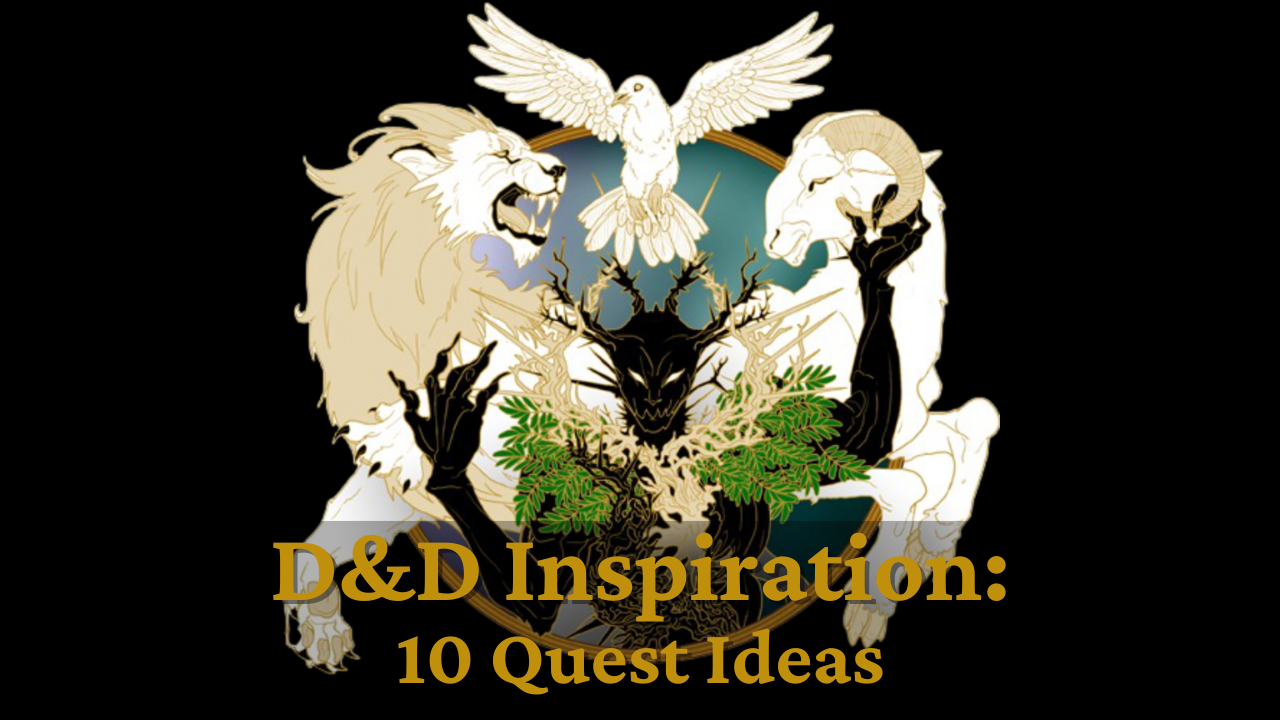
A D&D graphic with a lion, lamb, bird, and horned figure. Text reads

Transcribed content from our recent YouTube video: https://www.youtube.com/watch?v=3bMjDsFmYAc&ab_channel=EternityTTRPG


Transcription

Need some quick D&D quest ideas to throw at your players? Whether they’ve derailed your main storyline or you just need some fast inspiration, I’ve got 20 quests ready from my own 25+ years of D&D campaigns and one-shots that you can drop for your party at your next gaming night. From cursed artifacts to insane boss fights, these ideas will keep your party rolling dice all night long.


Welcome back to Eternity TTRPG—your go-to source for all things Dungeons & Dragons. Today we’re counting down 20 quest and side quest ideas you can use instantly in your next game. Let’s dive in.”


10. Lava Core


On the surface, this is a simple delivery quest—escort a wagon of supplies to a nearby town. But once the party leaves, the entire town erupts in flames. The merchant they worked for tricked them into delivering a magical explosive called the Lava Core to wipe out a secret organization. Now the players are left with guilt, betrayal, and a tough decision—do they hunt down the merchant, or try to redeem themselves?


9. The Jester’s Court


Deep in the frozen tundra, a half-insane demi-god known as the Jester builds a kingdom of monsters. Think undead, beasts, demons—all following his twisted command. His influence spreads like wildfire, and the only way to stop him is to march into his icy castle and confront him directly. Of course, everyone knows that’s basically suicide. Which makes it the perfect quest for high-level heroes.


8. Three Sisters


Here’s a boss fight with a puzzle built in: three enemies, known as the Sisters, must be killed in the correct order. If not, the survivors resurrect the fallen one on their next turn. The party needs to uncover hints about the order—maybe from a prophecy, maybe from symbols on their armor—before the fight turns into an endless nightmare. It’s a perfect way to mix combat and problem-solving.


7. Ruins of the Tree of Life


This dungeon takes place inside the mile-high corpse of the Tree of Life. Its rotting branches are filled with undead and pestilence, and at the top lies a black crystal prison holding Ranroth the Betrayer. Only, that prison is cracked and about to shatter. Do the players attempt to repair the seal, or prepare for the return of one of the realm’s greatest enemies?


6. Fang of Lanias


This is the tooth of a fallen golden dragon. Whoever holds it can summon the ghost of Lanias—but instead of a wise guardian, the spirit attacks anyone who enters his ruined spire. If the party doesn’t banish him properly, Lanias resurrects at midnight every night, forcing an endless cycle of battles. Do your players destroy the fang, or find a way to put this restless dragon to peace?


5. Ultimate Vampire


Vampires are scary enough, but this one is pure nightmare fuel. At the start of combat, he drains one character level from each party member, and he rips away their strongest magic item, adding its powers to himself. Imagine watching your sword of legend floating in his hands as he uses it against you. It’s a brutal reminder that sometimes, the deadliest monsters aren’t just strong—they’re thieves of everything you hold dear.


4. Crypt of the Plaguebringers


Plagues are spreading across the realm, and clerics can’t heal them. Why? Because it’s no ordinary sickness—it’s fueled by a cult using trapped spirits from a hidden crypt. If the party doesn’t stop them within thirty days, the plague will cover the land. To make it worse, the spirits themselves whisper to the heroes in their dreams, offering dark bargains in exchange for helping, rather than hindering them.


3. Future Disaster


Not every quest the heroes undertake has a happy ending. A humble family asks the party to mentor their gifted child in magic. Over time, the child becomes a prodigy—but also grows up watching the adventurers use their power to shape the world. Eventually, that child returns as the party’s greatest enemy, convinced they can rule better than their mentors. It’s a heartbreaking story of legacy and unintended consequences.


2. Reverse


This boss breaks one of D&D’s core rules: damage heals them, and healing hurts them. Imagine the party unleashing fireballs, only to see the monster’s wounds close tighter each time. The only way to kill it is through healing spells or potions, which means your party’s cleric suddenly becomes the MVP damage dealer. It’s one of those fights that makes your players go, ‘Wait… what?!’ Or, imagine if they have no dedicated healer in the party and now must win using an entire town’s literal stockpile of healing potions.


1. Unicorn Meat


A vendor in the town square loudly declares he’s selling—yes, you heard it right—fresh unicorn meat. It shimmers rainbow hues, smells like summer fields, and nobles are lining up to buy it by the pound.


The butcher swears it’s ethical—‘No problem if you *find* them dead!’ he says. But his business is booming so fast he needs help finding more. That’s where the party comes in: track down dead unicorns, bring back the meat, and he’ll cut them in on the profits.


Of course, unicorns don’t usually drop dead on their own. But if something is out there killing them, the heroes will have to decide—do they protect these sacred creatures, or cash in on the newest, most lucrative and controversial trade in the realm?


And that’s ten amazing D&D quest ideas—from tragic mentor-protégé betrayals to bizarre unicorn steaks. Which one would your players love—or absolutely hate—the most? Drop your pick in the comments, and don’t forget to like and subscribe for more D&D content every week. Until next time, may your dice roll high, and your weekly adventures always turn into legendary stories.

Share This Article

Jacob Tegtman Eternity TTRPG Creator

Author - Jacob Tegtman

Dear reader, I hope you enjoyed this article. Tabletop gaming has been a passion of mine since I was 6 years old. I've played just about every game from Dungeons and Dragons to video games like Final Fantasy. These games have inspired me, made me laugh, made me cry, and brought me endless hours of enjoyment.


I started Eternity TTRPG - and the indie tabletop game that goes along with it (Eternity Shop) - to share my love of gaming with others. I believe that in our technology-driven age, tabletop games help bring a sense of magic and community back into our world.


If you love the site, please share it with others! I have lots of gaming-related material for you to peruse and use in your own gaming sessions. If you have any questions about the site or want to contribute, just send me a message using the "Contact" page, which you can find in the site's footer.
Mythical winged beast with horns stands amid fire, titled
By Jacob Tegtman February 3, 2026
Transcribed content from our recent YouTube video: https://www.youtube.com/watch?v=Uajygh5mWSM Transcription “I once knew the kiss of the sun… Now, all that remains is annihilation.” This is how Crooked Moon ends. Not with a dungeon crawl. Not with a mystery. But with a reckoning—between a fallen god, a broken man, and the land they’re both about to destroy. Hey everyone, welcome back to Eternity TTRPG. If you’re new here, I break down tabletop RPGs and the great stories they tell—what they’re actually about, why they work at the table, and whether they’re worth your time. Today, we’re looking at one of my favorite campaign books of all time – and jumping right in to one of the best parts, which is the final chapter of Crooked Moon —the climactic conclusion everything in this campaign has been building toward. Jumping right in: the Wytchwood bends beneath the will of Kehlenn, the Crooked Queen —once the Green Queen, an archfey goddess of rebirth. Long ago, she ruled a world without people. A brutal, cyclical wilderness where life was short, terrifying… and natural. Then Phillip Druskenvald arrived. Somehow empowered, somehow victorious, he shattered her, buried her bones beneath a crooked oak, and reshaped the land into something civilized. Cities rose. People multiplied. And Kehlenn, broken, but somehow still alive, or conscious – remembered every second of it. Centuries of hatred twisted her into something new—not a goddess of renewal, but of vengeance. Her plan has been unfolding slowly, patiently, sacrifice by sacrifice… until now. Because Phillip has finally broken. Phillip Druskenvald was once the most powerful being in the land. Now he’s a grieving man who has lost everything. After the massacre at Rowan’s Rise earlier in the campaign book—and the death of Adela, the love of his life—Phillip retreats to the Green Queen Inn. There, surrounded by the stench of burned flesh and desperation, he turns to forbidden magic. The Old Ways. Resurrection. It fails. And in that failure, Kehlenn finally reaches him. She promises what no one else can: Adela’s soul. Redemption. A chance to undo his sins. So Phillip walks into the Wytchwood like a sacrifice that doesn’t yet know he’s already dead. This is where the players come in. They follow. The Wytchwood isn’t just a forest—it’s ancient, hostile, and alive. And it isn’t empty. Stalking the trees is The Horned King : a three-eyed, whispering embodiment of sin. A creature born from Phillip’s own soul, shaped by Kehlenn to be her consort and executioner. He doesn’t attack, but he tempts. He speaks to characters about their desires. Their doubts. Their secrets. He promises comfort. Power. Relief. This chapter isn’t just about fighting evil—it’s about confronting what your characters want most… and whether they’ll pay the price to get that desire. The whole Wytchwood is like this for the players – numerous challenging encounters, interwoven with direct and indirect influence from the shadowy horned king. Through it all, and finally, at the heart of the forest stands the Crooked Tree . Beneath it, in a root-choked barrow, Phillip kneels—bound, broken, and waiting. Kehlenn doesn’t hide anymore. She tells her story plainly. She was robbed. Forgotten. Replaced. And now, she will unmake everything Phillip built. Civilization. Memory. And identity itself. Phillip’s death, for her, will not be just vengeance—but it’s actually the final ingredient. The roots tighten. Phillip’s last word is a whisper. “Please… Adela.” And then he’s torn upward—into the tree. At this point, The true Horned King is born, with Phillip’s body and soul being the final missing piece. No longer a shadow, but a colossal, winged, horned monstrosity—part goat, part dragon, part man. Kehlenn watches from the bark of the Crooked Tree itself as the final battle begins. This is the end of Crooked Moon as a campaign. Players get to experience an amazing multi-phase fight. There’s ritual circle burning beneath a grinning moon. And, of course, a god screaming encouragement as her consort tries to tear the world apart. And when the Horned King finally falls—when his massive body collapses into blood, bone, and a single goat skull—it still isn’t over. Kehlenn still clings to the land. Sensing this, from the remains of the Horned King, a goat’s skull lies in the burning ritual circle, before the tree —cracked, it whispers to the characters, speaking with Phillip Druskenvald’s voice. Phillip, his soul barely intact, understands that killing the Horned King wasn’t enough. In reality, Kehlenn’s bond to the land still remains. Phillip’s soul, which helped fuel both the Horned King and Kehlenn’s ritual, is no longer fully consumed . So, what’s left of Phillip lingers in the goat skull as a final, conscious remnant. And in that moment, Phillip realizes that Kehlenn can only be severed from the land through sacrifice , not violence. So, the skull speaks, guiding the players toward the only remaining solution. The sacrifice to unbind Kehlenn requires that each character give something up—something meaningful. Fail, and the ritual completes. The Horned King returns. And most importantly, the world ends crooked: it continues, but in a more or less permanently corrupted state where the living are doomed to short, terrifying lives, but in an endless cycle. Succeed, however, and the Crooked Tree burns. If this happens, Kehlenn is bound to the moon she worshipped. Phillip and Adela fade together at last, their story finally at rest. Druskenvald survives. It carries the scars of what happened, and it will never be the same. And this is why Crooked Moon lands so powerfully. The finale is built on tragedy, temptation, and consequence, with an ending shaped by sacrifice rather than spectacle. What matters most is what the players are willing to give up to save the world – not just their combat stats. If you’re looking for a campaign that builds steadily toward a meaningful conclusion—one that rewards emotional investment and delivers a true sense of finality—this is the ending waiting for you in Crooked Moon. No matter how much time I spend in the Crooked Moon campaign setting, I continue to be ever more impressed. If you pick it up for yourself, I’d love to hear what experiences you have with your games! Lastly, to wrap up today’s video, I have a host of other Crooked Moon videos you may want to check out, that give greater context to this awesome campaign conclusion: race deep-dives, other adventures in the book, monstrous playable characters, the bestiary of boss monsters – and so much more. So, be sure to check out those videos if they interest you! Otherwise, thanks for watching, and I’ll see you in the next one.
Woman with feathered wings, a dragon behind her
By Jacob Tegtman January 28, 2026
Transcribed content from our recent YouTube video: https://www.youtube.com/watch?v=6eg7cXmFUVU Transcription Hey everyone! Welcome back to Eternity TTRPG. Today we’re firing up our Mark of Finding to uncover something huge for Eberron fans — the beloved sourcebook Exploring Eberron has officially relaunched on D&D Beyond as a fully supported digital release. Originally released back in 2020 on the DMsGuild as a third-party best-selling supplement by Eberron’s creator Keith Baker, Exploring Eberron was one of the most successful community books ever — and now it’s come full-circle. That means it’s now officially available on D&D Beyond, fully updated to use with the current D&D rules and integrated into D&D Beyond’s digital tools like the Character Builder and Maps VTT . So, you’re probably wondering – what’s inside the book? I’d say it’s deep content, not just lore, that the book dives into: First, we have: Setting Races & Cultures Exploring Eberron digs deep into the cultures and mindsets of iconic Eberron peoples like Changelings, Warforged, Kalashtar, Shifters, and Aereni elves. Rather than focusing on mechanics, these sections emphasize identity, societal roles, and story hooks that help these species feel rooted in the setting. Then there’s Planes of Existence & Manifest Zones The book offers a detailed look at Eberron’s unique planar system, where planes wax and wane in influence rather than remaining static. Manifest zones tie those planes directly to the world, creating locations where reality bends in ways that can dramatically shape adventures, cities, and campaigns. Next up is: Character Options Exploring Eberron includes a wide array of character options, from lore-driven subclasses to new species, feats, and spells, all updated for compatibility with the 2024 ruleset on D&D Beyond. These options are tightly woven into the setting, making them feel less like generic power boosts and more like natural extensions of Eberron’s world. One of my favorites is: Magic Items & Monsters The magic items and monsters in the book are designed to reinforce Eberron’s themes of magical industry, ancient empires, and strange planar forces. Many entries come with built-in story hooks, making them also quite useful for DMs looking to spark plot threads. And finally, we have Expanded Eberron Lore At its core, Exploring Eberron expands on the setting’s foundational lore, diving into the aftermath of the Last War, the influence of the dragonmarked houses, and the uneasy relationship between magic and technology. It provides context and nuance that help DMs portray Eberron as a world shaped by innovation, conflict, and moral ambiguity. In total, the digital book includes 6 subclasses, 10 species, 12 feats, 4 spells, over 40 magic items, and 8 monster stat blocks — not bad value. On D&D Beyond the digital book retails at $30 — basically what you’d expect for a mid-sized sourcebook. If you already own the original 2020 PDF or print version on DMsGuild, the rules aren’t exactly the same, as the original used older rulesets obviously, but the lore is still gold. So, is it worth it? If you’re deep into Eberron, love D&D Beyond functionality, or want all your content integrated cleanly into the builder and VTT, then this is a no-brainer. But if you’re happy with the DMsGuild version and don’t use Beyond much? You might stick with what you have — it’s still solid and compatible. Nothing crazy groundbreaking here, to be honest. Exploring Eberron on D&D Beyond is a fantastic evolution of one of the setting’s best third-party books, and it’s great to see it finally fully supported and updated. There is a lot here to love. Well, that is it for today, my friends. Let me know in the comments — are you grabbing this on D&D Beyond? Or sticking with your original edition? Otherwise, hit like, subscribe, and may your dice always roll well!
Final Fantasy TRPG layout: Mana grid graphic
By Jacob Tegtman January 20, 2026
Transcribed content from our recent YouTube video: https://www.youtube.com/watch?v=kPQfDB2cKSI Transcription Every Final Fantasy hero starts with a choice. Sword or spell. Raw power, or skill. But in Final Fantasy TRPG: Legend Edition, that choice doesn’t stop at your Class — it’s defined by the Jobs you choose from your class, the Circles you unlock, and the Limit Breaks that change the tide of battle. Today, we’re breaking down how Classes and Jobs actually work in Final Fantasy TRPG: Legend Edition — and how they shape your character from level one… to the final boss. Hey everyone, welcome back to Eternity TTRPG channel! If you caught one of my recent videos from before the holidays, we went deep into the Final Fantasy TRPG: Legend Edition core rulebook — and today we’re diving into one of the most iconic elements of any Final Fantasy system: Classes and Jobs ! Whether you’re planning your first character or optimizing a seasoned hero for this recently-released game, this guide has you covered. One of the longest-standing traditions in Final Fantasy is its Job system , and Legend Edition embraces this fully. Classes in this game are the framework or chassis of your character — they determine your character’s HP, MP, trained Skills, associated Jobs, and your Class Limit Break . Jobs are where the cool stuff really happens. Each Job is a set of abilities on a progression track, granting new Features at specific levels — these are called Circles . And you don’t just pick one — your character ends up with three Jobs (or four with optional full buy-in), each advancing at a different speed to give you abilities every level. There are four broad Classes you’ll choose from. Each class has what you could consider as subclasses – in Legend Edition, these are the “Jobs.” So, for example, some of the Warrior Jobs are berserker, dervish, dragoon, fighter, monk, samurai, and so on. So, let’s dive into the four classes: Number 1 - Warrior Masters of physical combat, Warriors excel in strength, endurance, and frontline fighting. Their Limit Break — Action Surge — lets them make extra attacks during an encounter, perfect for dealing burst damage. 2. Expert Battlefield manipulators and support roles go here. Experts rely on their wits and skill versatility, and their Limit Break — Savant — adds bonus dice to Skill rolls based on their level. 3. Mage If magic is your playstyle, Mages are your go-to. They lean into Spellcasting and area of effect mechanics. Their Turbo MP Limit Break doubles the effectiveness of MP spent on magical abilities during an encounter. And number four is Adept The hybrid class — versatile, adaptable, and capable of mixing physical and magical roles. Adepts don’t have a unique Limit Break; instead, they choose one from the other three classes, based on their job build. Now here’s where Legend Edition gets fun. Across the system are 50+ Jobs drawing inspiration from classic Final Fantasy favorites — think Black Mage , Dragoon , Thief , and more — giving you a huge palette of archetypes to mix and match. Each Job grants seven Features – called Circles – over its progression, spaced across levels based on whether the Job is on a Fast, Medium, or Slow advancement track — meaning strategic choices shape how your character evolves through the campaign. So, for example, you may choose the Warrior class because you like its HP, MP, and Skill point advancement numbers, you like its limit break, and you enjoy playing that overall archetype for your character. Then, you pick three Jobs to fill out your character. Say that you want a full warrior build, so you choose your three jobs to be: Dragoon, Knight, and Monk. From here, you’d decide which of those three jobs would be on your Fast advancement track, which should go on your Medium track, and which will be on your slow advancement. Important note here though: only one of your Jobs needs to be associated with your Class. That means the rest can actually be totally outside that box — so yes, you can be a Mage-warrior hybrid if it fits your concept! You could be a warrior class, with the Dragoon, Black Mage, and Chemist jobs. So, here’s the quick breakdown of Job progression: Fast Progression: Abilities at levels 1, 3, and every 3 levels thereafter Medium Progression: Abilities at levels 1, 4, and every 3 levels thereafter Slow Progression: Abilities at 2, 5, and every 3 levels thereafter This staggering system means every level feels like a growth moment. You get new Abilities (“Circles”) from all three of your jobs at the same cadence. But at the same time, you get Circles from the Jobs that are most important to you, at earlier levels. The rule book mentions this too, but if you do want to try out this awesome system, I’d recommend that you don’t stress too much about your first Job choices. There’s a ton of options here, which is great for replayability, and experimenting with side campaigns. But, there’s also too many Jobs to really nail down what you want to ideally play, the first time you try out this game. Probably instead, just pick classes that sound fun, and give it a whirl. To wrap up this video, I’m going to cover my personal favorite Job from each of the first three Classes. Since there’s over 50-jobs, there’s too many for me to dive into – at least today. But hopefully these quick snapshots give you a picture of how Jobs work, what kind of Abilities each provides, and some inspiration for your upcoming game: If I was to play a Warrior Job, I’d start with Dragoon: As you probably know, Dragoons are also often known as Dragon Knights . Dragoons are aerial combat specialists who use momentum for power. Originally trained to pierce the hides of massive foes like dragons, their style revolves around leaping high above the battlefield and crashing down with overwhelming force. Depending on the setting, Dragoons may hunt dragons, fight alongside them, or carry on their legacy after their extinction — but they’re almost always portrayed as guardians who stand against towering threats . In play, Dragoons are defined by the Jump and Blood of the Dragon Circles . Jump removes them from the battlefield for a round before returning with an automatic, high-impact strike. Meanwhile, critical hits generate Blood of the Dragon to fuel powerful Dragon Arts , which are the Dragoon’s situational combat techniques that modify your attacks, defenses, or Jump actions, for additional benefits. Next up, for the expert class, I’d probably start with Squire – I just have so many good memories from playing Final Fantasy Tactics: Instead of perfecting a single discipline, Squires develop adaptability through experience and improvisation. That flexibility makes Squires exceptional team players , able to step into gaps and support allies in many situation. Mechanically, the Squire revolves around Fundaments — where they grant short-term bonuses to allies based on that ally’s Class. Warriors hit harder, Experts perform better at skills, Mages cast more effectively, and Adepts can receive whichever boost fits the moment. As the Squire advances through their Circles, they can grant Fundaments to multiple allies at once, add secondary effects like increased damage or longer debuffs. I’m not always a team buffer kind of guy, but I do like the way Squires here make everyone else better , turning party coordination into a great strength. For my third Job, I’ll choose from the Mage class. This one’s really hard for me as I could see myself actually going like 3/3 mage, or maybe 2/3, at least. But, if I had to pick just one for my remaining Job slot, I’d go with Necromancer: Necromancers are reclusive magic-users whose art is inseparably tied to death and the Shadow. Often misunderstood or feared, they’re immediately recognizable by their Bone Commander — an undead construct that serves as both assistant and bodyguard. While some Necromancers lean into darker reputations, others act as shamans or intermediaries, communing with spirits to resolve unfinished business or bring peace to the dead. Their morality isn’t defined by their magic, but by how they choose to wield it. In play, Necromancers are spellcasters with access to the Necromancy spell list and a powerful Companion system . Their Bone Commander acts on their shared action economy, providing combat presence without needing its own stats or hit points. Their Limit Break, Friends on the Other Side , allows damage from the party to count as Shadow damage, supercharging Necromancer features and reinforcing their role as battlefield controllers who blur the line between ally and undead asset. So! There you have it. From adaptable Squires and sky-shattering Dragoons to shadow-touched Necromancers and beyond, Legend Edition’s Classes and Jobs are all about expression through choice . Your Class sets the foundation, but your Jobs — and how you progress them — define how your character actually plays at the table. Legend Edition feels... unmistakably Final Fantasy. What I really want to know is... from the 50+ jobs available in Legend Edition, what three Jobs would best define your Character? List your Jobs in the comments. Otherwise, thanks for watching! If you enjoyed this breakdown of Classes and Jobs in Final Fantasy TRPG: Legend Edition, hit that like button, subscribe for more content, and ring the bell so you don’t miss our next video.
Show More