Final Fantasy TRPG: Legend Edition — Classes & Jobs Explained
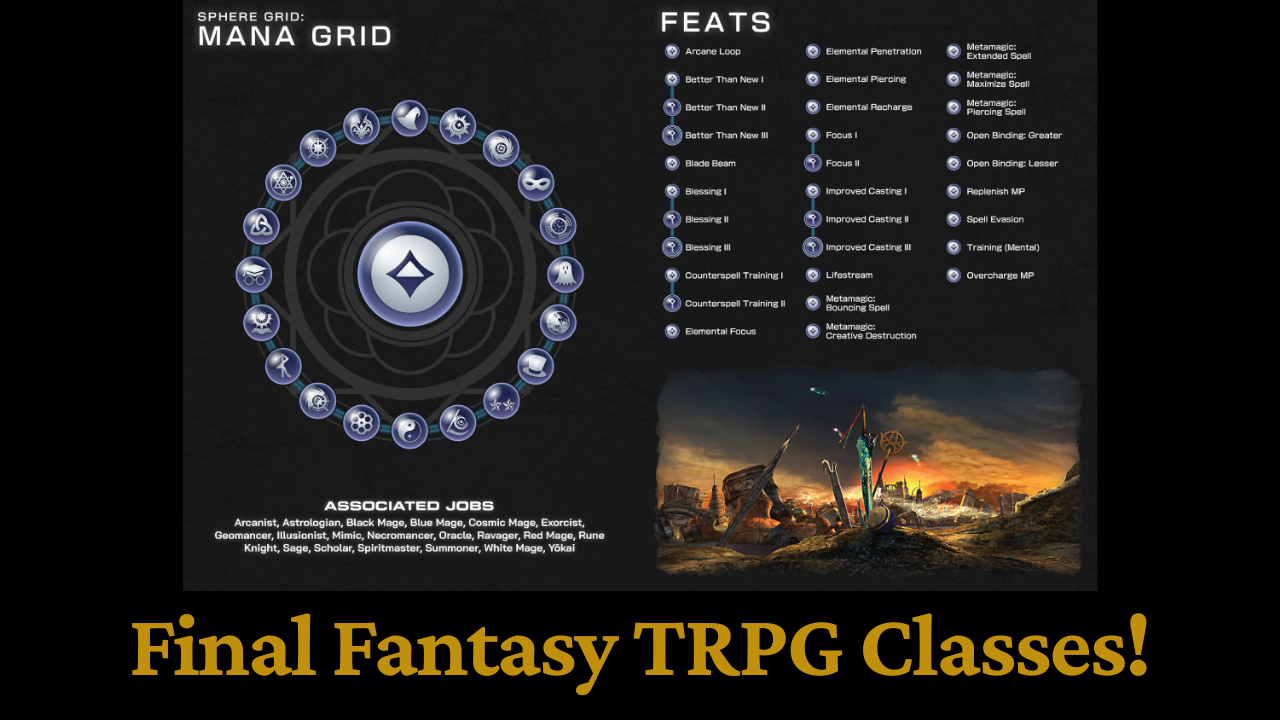
Diagram of Final Fantasy TRPG Classes with a Mana Grid

Transcribed content from our recent YouTube video: https://www.youtube.com/watch?v=kPQfDB2cKSI


Transcription

Every Final Fantasy hero starts with a choice. Sword or spell. Raw power, or skill.


But in Final Fantasy TRPG: Legend Edition, that choice doesn’t stop at your Class — it’s defined by the Jobs you choose from your class, the Circles you unlock, and the Limit Breaks that change the tide of battle.


Today, we’re breaking down how Classes and Jobs actually work in Final Fantasy TRPG: Legend Edition — and how they shape your character from level one… to the final boss.


Hey everyone, welcome back to Eternity TTRPG channel! If you caught one of my recent videos from before the holidays, we went deep into the Final Fantasy TRPG: Legend Edition core rulebook — and today we’re diving into one of the most iconic elements of any Final Fantasy system: Classes and Jobs! Whether you’re planning your first character or optimizing a seasoned hero for this recently-released game, this guide has you covered.


One of the longest-standing traditions in Final Fantasy is its Job system, and Legend Edition embraces this fully. Classes in this game are the framework or chassis of your character — they determine your character’s HP, MP, trained Skills, associated Jobs, and your Class Limit Break.


Jobs are where the cool stuff really happens. Each Job is a set of abilities on a progression track, granting new Features at specific levels — these are called Circles. And you don’t just pick one — your character ends up with three Jobs (or four with optional full buy-in), each advancing at a different speed to give you abilities every level.


There are four broad Classes you’ll choose from. Each class has what you could consider as subclasses – in Legend Edition, these are the “Jobs.” So, for example, some of the Warrior Jobs are berserker, dervish, dragoon, fighter, monk, samurai, and so on.


So, let’s dive into the four classes:


Number 1 - Warrior

Masters of physical combat, Warriors excel in strength, endurance, and frontline fighting. Their Limit Break — Action Surge — lets them make extra attacks during an encounter, perfect for dealing burst damage.


2. Expert

Battlefield manipulators and support roles go here. Experts rely on their wits and skill versatility, and their Limit Break — Savant — adds bonus dice to Skill rolls based on their level.


3. Mage

If magic is your playstyle, Mages are your go-to. They lean into Spellcasting and area of effect mechanics. Their Turbo MP Limit Break doubles the effectiveness of MP spent on magical abilities during an encounter.


And number four is Adept

The hybrid class — versatile, adaptable, and capable of mixing physical and magical roles. Adepts don’t have a unique Limit Break; instead, they choose one from the other three classes, based on their job build.


Now here’s where Legend Edition gets fun. Across the system are 50+ Jobs drawing inspiration from classic Final Fantasy favorites — think Black Mage, Dragoon, Thief, and more — giving you a huge palette of archetypes to mix and match.


Each Job grants seven Features – called Circles – over its progression, spaced across levels based on whether the Job is on a Fast, Medium, or Slow advancement track — meaning strategic choices shape how your character evolves through the campaign.


So, for example, you may choose the Warrior class because you like its HP, MP, and Skill point advancement numbers, you like its limit break, and you enjoy playing that overall archetype for your character.


Then, you pick three Jobs to fill out your character. Say that you want a full warrior build, so you choose your three jobs to be: Dragoon, Knight, and Monk.


From here, you’d decide which of those three jobs would be on your Fast advancement track, which should go on your Medium track, and which will be on your slow advancement.


Important note here though: only one of your Jobs needs to be associated with your Class. That means the rest can actually be totally outside that box — so yes, you can be a Mage-warrior hybrid if it fits your concept!


You could be a warrior class, with the Dragoon, Black Mage, and Chemist jobs.


So, here’s the quick breakdown of Job progression:

  • Fast Progression: Abilities at levels 1, 3, and every 3 levels thereafter
  • Medium Progression: Abilities at levels 1, 4, and every 3 levels thereafter
  • Slow Progression: Abilities at 2, 5, and every 3 levels thereafter


This staggering system means every level feels like a growth moment. You get new Abilities (“Circles”) from all three of your jobs at the same cadence. But at the same time, you get Circles from the Jobs that are most important to you, at earlier levels.


The rule book mentions this too, but if you do want to try out this awesome system, I’d recommend that you don’t stress too much about your first Job choices. There’s a ton of options here, which is great for replayability, and experimenting with side campaigns.

But, there’s also too many Jobs to really nail down what you want to ideally play, the first time you try out this game. Probably instead, just pick classes that sound fun, and give it a whirl.


To wrap up this video, I’m going to cover my personal favorite Job from each of the first three Classes. Since there’s over 50-jobs, there’s too many for me to dive into – at least today. But hopefully these quick snapshots give you a picture of how Jobs work, what kind of Abilities each provides, and some inspiration for your upcoming game:


If I was to play a Warrior Job, I’d start with Dragoon:


As you probably know, Dragoons are also often known as Dragon Knights. Dragoons are aerial combat specialists who use momentum for power. Originally trained to pierce the hides of massive foes like dragons, their style revolves around leaping high above the battlefield and crashing down with overwhelming force. Depending on the setting, Dragoons may hunt dragons, fight alongside them, or carry on their legacy after their extinction — but they’re almost always portrayed as guardians who stand against towering threats.


In play, Dragoons are defined by the Jump and Blood of the Dragon Circles. Jump removes them from the battlefield for a round before returning with an automatic, high-impact strike. Meanwhile, critical hits generate Blood of the Dragon to fuel powerful Dragon Arts, which are the Dragoon’s situational combat techniques that modify your attacks, defenses, or Jump actions, for additional benefits.


Next up, for the expert class, I’d probably start with Squire – I just have so many good memories from playing Final Fantasy Tactics:

Instead of perfecting a single discipline, Squires develop adaptability through experience and improvisation. That flexibility makes Squires exceptional team players, able to step into gaps and support allies in many situation.


Mechanically, the Squire revolves around Fundaments — where they grant short-term bonuses to allies based on that ally’s Class. Warriors hit harder, Experts perform better at skills, Mages cast more effectively, and Adepts can receive whichever boost fits the moment. As the Squire advances through their Circles, they can grant Fundaments to multiple allies at once, add secondary effects like increased damage or longer debuffs. I’m not always a team buffer kind of guy, but I do like the way Squires here make everyone else better, turning party coordination into a great strength.


For my third Job, I’ll choose from the Mage class. This one’s really hard for me as I could see myself actually going like 3/3 mage, or maybe 2/3, at least. But, if I had to pick just one for my remaining Job slot, I’d go with Necromancer:


Necromancers are reclusive magic-users whose art is inseparably tied to death and the Shadow. Often misunderstood or feared, they’re immediately recognizable by their Bone Commander — an undead construct that serves as both assistant and bodyguard.


While some Necromancers lean into darker reputations, others act as shamans or intermediaries, communing with spirits to resolve unfinished business or bring peace to the dead. Their morality isn’t defined by their magic, but by how they choose to wield it.


In play, Necromancers are spellcasters with access to the Necromancy spell list and a powerful Companion system. Their Bone Commander acts on their shared action economy, providing combat presence without needing its own stats or hit points. Their Limit Break, Friends on the Other Side, allows damage from the party to count as Shadow damage, supercharging Necromancer features and reinforcing their role as battlefield controllers who blur the line between ally and undead asset.


So! There you have it. From adaptable Squires and sky-shattering Dragoons to shadow-touched Necromancers and beyond, Legend Edition’s Classes and Jobs are all about expression through choice. Your Class sets the foundation, but your Jobs — and how you progress them — define how your character actually plays at the table. Legend Edition feels... unmistakably Final Fantasy.


What I really want to know is... from the 50+ jobs available in Legend Edition, what three Jobs would best define your Character? List your Jobs in the comments.


Otherwise, thanks for watching! If you enjoyed this breakdown of Classes and Jobs in Final Fantasy TRPG: Legend Edition, hit that like button, subscribe for more content, and ring the bell so you don’t miss our next video.

Share This Article

Jacob Tegtman Eternity TTRPG Creator

Author - Jacob Tegtman

Dear reader, I hope you enjoyed this article. Tabletop gaming has been a passion of mine since I was 6 years old. I've played just about every game from Dungeons and Dragons to video games like Final Fantasy. These games have inspired me, made me laugh, made me cry, and brought me endless hours of enjoyment.


I started Eternity TTRPG - and the indie tabletop game that goes along with it (Eternity Shop) - to share my love of gaming with others. I believe that in our technology-driven age, tabletop games help bring a sense of magic and community back into our world.


If you love the site, please share it with others! I have lots of gaming-related material for you to peruse and use in your own gaming sessions. If you have any questions about the site or want to contribute, just send me a message using the "Contact" page, which you can find in the site's footer.
A vampire sits on a dark throne holding a wine glass, with the text
By Jacob Tegtman March 11, 2026
Transcribed content from our recent YouTube video: https://www.youtube.com/watch?v=2z2fTaAQS3g Transcription For months the D&D community has been asking the same question… “Where are all the new books?” Well—Wizards of the Coast finally answered. 2026 is bringing Ravenloft horror, high-magic arcana, a Feywild heist romance, and… a crochet owlbear. Yes. Really. Today we’re breaking down every single Dungeons & Dragons book announced for 2026 —what they are, who they’re for, and which ones might actually change your campaign. Welcome back to Eternity TTRPG—your party’s reliable source for Dungeons & Dragons news, lore, and tabletop chaos. Today we’re going through the entire 2026 D&D release schedule . There’s quite a few books, so this list is meant to give you the quick, clean, and minimal filler low-down. If anything sounds good, you have something to start on for your own in-depth research. So, let’s get started. The biggest announcement so far for 2026 is: Ravenloft: The Horrors Within , Releasing June 16th, 2026. This new sourcebook expands the Domains of Dread , the gothic horror setting originally ruled by Strahd. For Dungeon Masters, the book adds: • new Darklords • new monsters • and expanded guidance for running horror-themed campaigns . That includes subgenres like: • gothic horror • cosmic horror • and psychological horror. Players get new options too: • horror-themed subclasses • new species and backgrounds • and expanded Dark Gift feats . The book also expands the fear and dread mechanics , which could add some serious tension to horror campaigns. And yes… Legendary monster hunter Rudolph van Richten is making another appearance. Preorders begin April 13th , and digital versions hit D&D Beyond early in June . So horror fans—Is Ravenloft your favorite setting, or are you still loyal to Curse of Strahd? Then in September 2026 , we get one of the most mysterious releases: Arcana Unleashed. Wizards of the Coast calls it a “high-magic sourcebook.” What we know so far is that it introduces new arcane subclasses from earlier Unearthed Arcana playtests. Plus: • new spells • magic items • artifacts • and expanded customization options. But the biggest addition might be a new “evolving magic item” system . That means magical gear that levels up alongside your character, which if done properly – could be pretty cool. This kind of thing could also change how treasure progression works in campaigns. We also know though that if this idea is done poorly… Well… could lead to certain things from this book being banned at some tables. Launching alongside Arcana Unleashed is an adventure expansion called: Arcana Unleashed: Deadfall. This adventure ties directly into the main Arcana Unleashed book and features the infamous Red Wizards of Thay . The story reportedly involves a massive magical war , with new lore about the organization. And interestingly… A Red Wizards adventure was originally teased way back in 2023’s D&D Direct event , so this might finally be that storyline. We don’t yet know if this will be: • a full physical book • or only a digital D&D Beyond adventure . But if you like Forgotten Realms villains… The Red Wizards are about as dangerous as it gets. Next up is something aimed at specifically Dungeon Masters : the Dungeon Master’s Workbook of Worldbuilding, releasing May 5th . This one is all about building better campaigns. The book includes exercises designed to help DMs: • design campaign worlds • create memorable NPCs • build maps • and improve improvisation skills. Which honestly might be the most important DM skill of all. Because no matter how much you prepare… Players will always find a way to kick down the door that has nothing behind it. At least until you create something on the fly, that is. So, this workbook aims to help DMs build living worlds instead of static storylines. I got some really great advise when I first started DMing, which was to steal everything. I think these kind of thought-provoking books help synthesize great material into something that’s also – at the same time – entirely your own. Alongside the DM book, and launching the same day, is something aimed at new players and storytellers . This is an interactive companion to the D&D 5.5e Player’s Handbook . Instead of rules, the book focuses on guided character creation . It includes prompts that help you: • build backstories • connect your character to the party • and design personal motivations that actually matter in the campaign. Think of it like a creative writing workbook for D&D characters. If you’ve ever stared at a blank character sheet thinking… “Uh… I guess I’m an edgy rogue with amnesia? Oh yeah, and I’m an orphan – definitely, always an orphan.” This book might actually help. And I mean that in a kind way. Nearly everyone benefits from a bit of help thinking through interesting character creation, without relying on the same tropes that Final Fantasy characters have been relying on for a few decades. Then, we have something completely different. The Feywild Job releases June 30th . And this one is actually a D&D novel , not a game book. It’s written by C.L. Polk , a Nebula and World Fantasy Award-winning author. The story follows two former lovers turned thieves hired to steal a magical artifact from the Feywild. So imagine: • magical heist story • romantic tension • with chaotic Feywild politics. Basically romantasy meets D&D crime caper. Which honestly feels like the most Feywild thing possible. Every now and then I can get into a D&D novel. Maybe you’re like me and it’s been enough time to give a new novel a try. Finally, we have Dungeons & Dragons Crochet: A Book of Many Patterns. Yes—this is a real official D&D book. Written by longtime D&D contributor Stacy King , it includes 20 crochet patterns inspired by the D&D multiverse . We’re talking: • Owlbear cub plushies • Mini beholders • And even a handmade Bag of Holding So, this obviously isn’t a rules book. It’s basically crafting for D&D fans who want to bring the monsters to life—literally in yarn. Kind of like D&D cook books, but crafts version. Which, by the way, I’ve seen a lot of these kind of things selling like hot cakes at local conventions, so you know it’s going to be in-demand. Buy it for the ladies in your weekly D&D group who are into crochet. Ok, so I lied. There’s a bonus round here, which is one possible future release. There are strong hints that Dark Sun might be returning, which I shared about a couple months ago in a previous video. Recent playtests included subclasses tied to the setting like: • Gladiator Fighter • Defiler Sorcerer • and Sorcerer-King Warlock. Those are classic Dark Sun themes . So, while nothing is officially confirmed… It’s very possible we’ll see a new Athas sourcebook in 2027. And if that happens? It would be the first major Dark Sun release in decades. I’d be super into seeing something like that come down the pipeline. That’s the full Dungeons & Dragons book roadmap for 2026. From crochet monsters… To gothic horror… To evolving magic items. It’s actually a pretty diverse lineup. But, now I want to hear from you: Which of these books are you most excited for? And which one are you skipping entirely? Drop your thoughts in the comments. And if you want more weekly D&D news, lore, and tabletop chaos— Make sure you subscribe. Until next time… May your dice roll high and your players never step through the door that you never prepared for.
Dungeons & Dragons logo with text:
By Jacob Tegtman March 4, 2026
Transcribed content from our recent YouTube video: https://www.youtube.com/watch?v=9vE0niUm8vU Transcription Wizards of the Coast has finally done it. After years of calling it “One D&D(?)”… then “D&D 2024”… and pretending it wasn’t a new edition, while kind of also insisting that it was… They’ve now officially named it what I had assumed the community at-large has been referring to it as now for probably at least a year, which is: D&D 5.5e. Was this the right call? Did, in fact, the community already decide this for them? And does this mean we’ve now officially entered into an edition war era again? Let’s talk about it. Welcome back to Eternity TTRPG — your go-to source for all things Dungeons & Dragons. Today we’re breaking down Wizards of the Coast’s official confirmation that the latest, 2024 rules update is now officially known as D&D 5.5e , what it means for the community, and whether this name change actually does anything. So, after years of brand confusion, Wizards of the Coast has indeed officially confirmed via a detailed FAQ that the 2024 rules update will now be called: Dungeons & Dragons 5.5 Edition. On D&D Beyond, all 2024 material will carry a “5.5e” tag, while legacy 2014 content will simply remain labeled “5e.” According to the FAQ, the reasoning is simple: Players mixing 2014 and 2024 content were confused about which rules applied. Which, yeah. No kidding. And honestly? If you’ve ever tried building a character using mixed subclasses, spells, and feats… you know that confusion is real. For years this thing – this edition – has had an identity crisis. First it was called One D&D — for some reason – positioned as “the future of D&D.” Then marketing shifted heavily toward “D&D 2024.” And now? We’re back to the old-school edition numbering convention. Wizards of the Coast says using “5e” and “5.5e” makes it quicker and easier to tell what rules you’re using — especially on digital platforms. Which, I agree. I actually got my start into D&D during the 3.5e era, so nothing crazy there for my generation. From a UX standpoint I think this also makes sense, especially as D&D continues to push their online gaming and presence. D&D Beyond has kind of always been a bit of a mess, to be honest. So any naming convention upgrade to simplify is kind of a win in itself. But here’s where it gets interesting… Wizards claims that “5.5e” matches how the community already talks about the game. But, to my surprise, it turns out the data tells a slightly different story. According to Google Keyword Planner data (March 2, 2026) — filtered across the US, Canada, UK, and Australia — here’s how the search terms stack up: “dnd 2024” – 6,600 monthly searches (+50% Year over year growth) “dnd 5.5e” – 1,300 monthly searches (+19% Year over year growth) “dnd 5.5” – 1,000 monthly searches “d&d 5.5e” – 140 monthly searches So while “5.5e” and its variant search options is growing… “D&D 2024” absolutely dominates search volume — almost 2.5x higher, and growing substantially faster, it turns out. Now, that doesn’t mean 5.5e won’t become standard over time. Especially with this “official switch,” it will. But this is an interesting choice since – this admittedly limited data, shows – that people were perhaps by-and-large finally beginning to actually adopt the “D&D 2024” title. So, I don’t think I’ve ever mentioned this on the channel, but my main profession is marketing. One small thing that immediately comes to mind is social media hashtags. You can’t use a period in hashtags. That means: #dnd5.5e – that’s out So is it #dnd55e then (?) #dnd2024, however, totally fine All this to say is that from a modern branding and searchability standpoint, “D&D 2024” is cleaner. It’s more searchable. More social friendly. Maybe a little easier to type. So this decision feels less like a marketing move… and more like a database clarity move. This is about tagging systems. Cataloging. Digital sorting. I think D&D is still having a bit of an identity crisis, basically. And with all this, here’s the bigger philosophical question. If it’s called 5.5e… Does that mean it’s officially a half-edition? Historically, we’ve seen this before. Like I’ve referred to a couple times already, Wizards of the Coast released 3.5e back in 2003 — and that absolutely felt like a mechanical overhaul. But 5.5e? Is... more like a systemic refinement. Core math remains largely intact. Bounded accuracy is still king. Monsters hit differently, classes are tuned, spells adjusted… But I’m not sure I’d say it’s such a huge departure from 5e, like perhaps 3.5e was from 3e. The community sentiment is mixed. Some players are relieved there’s finally more clarity. Others feel like the branding mess could have been avoided entirely, and I certainly agree with that. And then there’s the group that’s been calling it 5.5e for two years going, saying: “I told you so.” Ultimately though? The name doesn’t change the gameplay. By most metrics, the 2024 rules have been widely adopted and actively played. Which means whether you call it: 5.5e 5e 2024 One D&D Or “The Patch Update” The dice still roll the same. This move feels like an administrative correction. Maybe it’s helpful for clarity, but isn’t really what D&D needs to move forward right now after all of the mixed feelings people have had about D&D, Wizards, and Hasbro. Wizards of the Coast is aligning the digital ecosystem with how people track rules versions internally. Will 5.5e stick? Probably. Will people still Google “D&D 2024” for years to come? Absolutely. You know they will. But at the end of the day… A game by any other name still crits on a 20. So, what are you calling 5.5e at your table? Thanks for watching today! If you want more weekly D&D news, rule updates, and community deep dives — make sure you like, subscribe, and ring the bell. Otherwise, I’ll see you next session.
D&D book cover: adventurers face a huge monster with a snowy-white head. Emerald and blue hues create a forest scene.
By Jacob Tegtman March 1, 2026
Transcribed content from our recent YouTube video: https://www.youtube.com/watch?v=BvU0p3UMOiU Transcription What if I told you there’s a brand-new D&D book…  where your party is supposed to die? Not “might.” Not “if you roll badly.” But guaranteed total party annihilation. And now it’s officially on D&D Beyond . Today we’re diving into Faster, Purple Worm! Everybody Dies, Vol. 1 — the adventure anthology where death isn’t a failure… it’s the feature. Let’s talk about what’s inside, what’s new, and whether this is actually one of the best low-level chaos tools of 2026. It’s been a minute guys, but welcome back to Eternity TTRPG, your go-to source for all things Dungeons & Dragons — from rule shakeups to purple worm-sized chaos. Last summer, third-party RPG publisher Beadle & Grimm’s released something… deeply unhinged. A 138-page anthology. 15 one-shot adventures. All for level 1 characters. All playable in 1–2 hours. And every single one ends in a Total Party Kill. Not “balanced.” Not “scalable.” Not “talk it out with the villain.” Just. Dead. The book ties directly into the actual play series Faster, Purple Worm! Kill! Kill! , which features celebrity players like Deborah Ann Woll , Seth Green , Anjali Bhimani , and co-founder Matthew Lillard . The whole concept? Lean into the absurdity of low-level adventurers making catastrophically bad decisions… and go full cinematic disaster mode. And honestly? That’s kind of genius. Because most tables never actually experience a true TPK. And this book says, “Cool. Let’s make that the entire point.” So what’s new now that it’s on D&D Beyond ? Mechanically? Same 15 adventures. But digitally? It’s juiced up. You get: 11 Quickplay Maps integrated into the Maps VTT 25 monster stat blocks (9 brand-new creatures + 16 variants) 17 new magic items ready to drop into character sheets 8 shareable handouts That’s actually pretty solid integration. And here’s the real surprise… The price. On D&D Beyond? $19.99. Compare that to: $45 for print $25 for PDF $50 for bundle That’s… unusually reasonable. For D&D... to be honest. Which is not something we say often about digital toolsets. Content-wise, it also leans into classic D&D chaos — including trips to Strahd von Zarovich in Barovia , and even tangling with the beholder crime lord Xanathar . Level 1 characters. Against that. You already know how that ends. If you’re newer to the scene, Beadle & Grimm is known for their ultra-premium boxed editions of official 5E books. We’re talking: Physical handouts In-world props Encounter cards Massive maps High-end collector-tier stuff. Founded in 2018 by Matthew Lillard and partners, they built a reputation on premium experiences. But this anthology? This is original content. Not just luxury packaging. And that’s interesting. Because it signals something bigger: Third-party publishers integrating more directly into official digital ecosystems. That’s a big deal. Here’s why this isn’t just a novelty book. It’s low-commitment D&D. Perfect for new players. It reframes failure as entertainment. Which is actually very healthy for the hobby. We can all take a solid step away from min-maxing, and pretending like we all need to be “good” at our favorite hobby, which to me is often besides the point of “having fun.” Three - It gives DMs a safe sandbox for chaos. Ever wanted to: Drop a meteor? Let the villain monologue uninterrupted? Run a trap that is wildly unfair? Now you can. Because the players know. They signed the waiver. And weirdly? That kind of expectation-setting creates some of the most memorable tables. This also feels very aligned with modern D&D culture — faster, punchier, content-friendly sessions. And for $20 digital? This might quietly become one of the best pickup party-night modules out there. We’ve seen serious campaigns. And they’re awesome. We’ve seen grimdark epics. And they’re also awesome. But this? This is D&D saying: “What if we just lean into the madness?” And honestly… I love it. Would you run a guaranteed TPK night at your table? Or is that sacrilege? Let me know in the comments. If you enjoy weekly D&D news, breakdowns, and community chaos — hit like, subscribe, and ring the bell. And tell me: What’s the wildest TPK you’ve ever experienced? That’s it for today! Until next time all, I’ll see you next session.
Show More