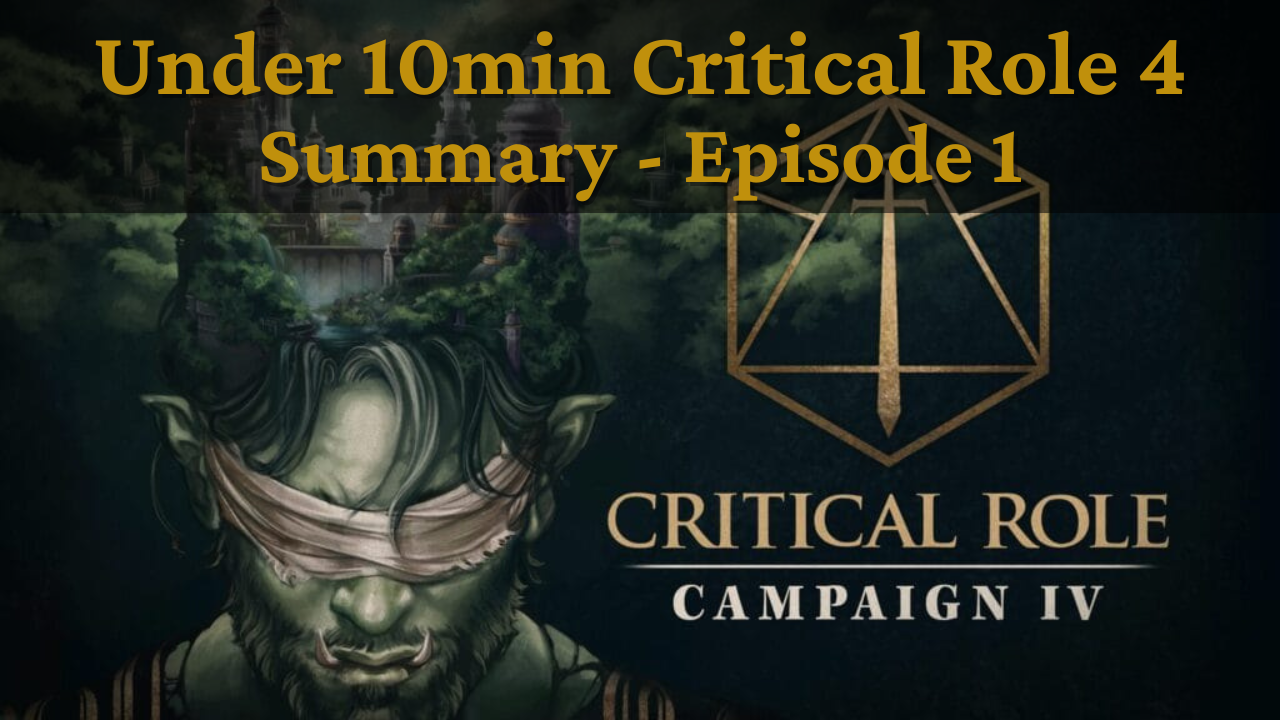
Under 10min Summary of Critical Role Season 4 - Episode 1
D&D crossover with Magic: The Gathering. Fantasy characters reading a book, magical setting with colors.

Transcribed content from our recent YouTube video: https://www.youtube.com/watch?v=6-EVzgJ_nSs


Transcription

It’s been a while, but welcome back to Eternity TTRPG. I’ve had a bit of a hiatus, but back to bringing you awesome news in the D&D space – this time, with quick summaries of the Critical Role 4 campaign thus far.


Whether you’re a fan of Critical Role, or you’ve heard about it and you’re curious on what it’s all about, these summaries will be in the range of 5-10min, so you can hear what’s happening without the full time commitment of watching an episode.


Additionally, stick around to the end, because I’m also pulling out a few tips from the Critical Role campaign — storytelling tricks, DM inspiration, and roleplaying ideas you can borrow for your upcoming game night to get the most magic from your adventures.

So with that, today we jump into Episode 1 — The Fall of Thjazi Fang.

  • The campaign opens in Dol-Makjar (doll mak-JAR), in the land of Kahad [KAH-had] (in the world of Aramán [AH-rah-man]).
  • Thjazi Fang, a war hero of the Falconer’s Rebellion and former mercenary with the Torn Banner, is scheduled for execution by the Chamber of the Lords-Advisory.
  • Arcane Marshal Azune Nayar (Ah-ZOO-nay NAY-ar) — once a comrade — inspects him for magical glyphs. He uncovers one on Thjazi’s back and secretly passes a message of hope.
  • As Thjazi is led to the gallows, he speaks telepathically with his brother Halandil (ha-LAN-dil) Fang “Hal” Fang, who is in the crowd.
  • Thjazi sees something ominous in the sky, urgently tells Hal to “help Murray at the Penteveral, paint is waiting for Bolaire, tell Thimble not to be afraid,” and defiantly proclaims the coming fall of false authority — then is hanged.
  • The crowd reacts with grief, shock, and political tension.
  • After the execution, Hal readies a farramh (FAH-rahm) — an orcish custom for viewing the body — at his home, with his daughter Shadia (SHAH-dee-uh), members of his theater troupe, and guests.
  • Thaisha Lloy (THAY-sha Loy), an orc druid, and Occtis Tachonis (OK-tis ta-KO-nis), a human necromancer student, arrive early. Both had ties to the rescue attempt of Thjazi.
  • Thaisha is ex-partner to Hal; they share a daughter Shadia and a son Alogar. Occtis is investigating his role in the failed plan to save Thjazi.
  • Azune brings Thjazi’s body to the wake.
  • Teor Pridesire (TEE-or pry-de-SEER) and Commander Loza Blade (former Torn Banner) honor Thjazi’s memory. Loza reminisces about Thjazi’s rise from common birth to rebellion.
  • Wicander (wi-KAN-dur HAL-o-var) “Wick” Halovar and Aspirant Tyranny (uh-SPY-rant TYR-uh-nee) arrive as emissaries of House Halovar. Wick, a cleric devoted to the Candescent Creed (kan-DES-sent kreed), brings Thjazi’s scimitar and laments that he couldn’t prevent the execution.
  • Wick reveals he pleaded with his grandmother, Photarch Yanessa Halovar, to spare Thjazi — but was rebuffed.
  • Tyranny, a demon in service to House Halovar, drinks at the funeral, teasing Wick, testing boundaries.
  • Thaisha drunkenly explains that she and Hal fell in love in their youth, but she felt a pull toward the wider world beyond their small circle.
  • Azune and Occtis piece together how the rescue chain broke. They head out to find Thimble, a fairy rogue and Thjazi’s close friend.
  • In Thjazi’s apartment, ransacked, they find Thimble near death. Her memories flash back to Faerie, and she recalls the glyph she was supposed to deliver was interrupted.
  • Kattigan Vale, a drunken ranger who recognizes Teor and Azune, joins them. He uses Clues to determine that 7 masked assailants entered, 3 were killed, crow feathers left behind, and the Stone of Nightsong was stolen from Thjazi’s safehouse.
  • Thimble confirms: thieves attacked her as she tried to deliver the glyph. The wrong glyph was detected by Azune. The Stone of Nightsong is missing — someone betrayed Thjazi.
  • Back at the wake / gathering place (the Rookery):
  • Bolaire Lathalia, a warlock / curator, arrives to support Hal.
  • Aranessa Royce (uh-RAH-nes-sa ROYS), Thjazi’s grieving widow, enters with Sir Julien Davinos (sir joo-LYEN duh-VEE-nos), the man who brought Thjazi to justice and perhaps bore much resentment.
  • Julien taunts Thjazi’s memory, spits on his corpse, and clashes with Thaisha.
  • Murray Mag’Nesson (dwarven wizard of the Penteveral) arrives, triggering a moment of distraction.
  • Thaisha senses a shadow following Julien — the superstition of protection is broken; something dark has latched onto him.
  • Wick chastises Tyranny for her drunken antics, but also gives Hal Thjazi’s scimitar.


  • As night falls, Vaelus, an elven paladin (800 years old) and devotee of the dead goddess Sylandri, arrives. She demands the return of her property — the Stone of Nightsong, stating that Thjazi stole it.
  • It’s revealed that the Stone was made by Sylandri to guide elven spirits through the underworld. Without it, the journey may be blocked.
  • In an eerie moment, the silver box containing broken ceramic tiles flies open, forming a mask bearing uncanny resemblance to Bolaire’s face.
  • Vaelus demands Thimble’s whereabouts. The implication: Julien or someone close to him is connected.
  • The first episode ends with tension in the air: multiple factions now want the Stone, the betrayal is active, and the cast is drawn together by grief, mystery, and political intrigue.
  • We’re left with a firm reminder of the world’s lore: the Shapers (gods) were killed 70 years ago, magic is unstable, and the Sundered Houses (Royce, Halovar, Tachonis [ta-KO-nis], Einfasen [INE-fa-sen], Cormoray) wield enormous power.
  • The stakes are clear: retrieve the Stone. Unravel the betrayal. Discover who killed Thjazi — and why.


“So what can we learn from The Fall of Thjazi Fang?


First — start big. That opening execution isn’t just drama; it’s a crisis that instantly ties every character together. You don’t need a warm-up quest — drop your players into the fallout and let them claw their way through.


Second — make it personal. Every hero at the table had a history with Thjazi. That’s why it hits so hard. When your next campaign begins, link each PC to the same event — a death, a secret, a shared failure.


And finally — let failure stand. The rescue didn’t work, and that makes the story matter. When you let plans fall apart, the next victory your players earn will feel legendary. D&D heroes don’t always have to succeed. In fact, in many cases, the best stories come from failure or setbacks that shape the events to come.


If you adopt just one thing for your next session, I’d say: start with a crisis tied to your players, and let every character have skin in the game from the first moment. If you’re feeling up to it though, combine that with selective reveals, emotional stakes, and the room to fail, and you’re halfway to a compelling campaign.


And there you have it — a full dive into Episode 1 of Campaign 4: the execution, the betrayal, the stolen artifact, and the gathering storm.


If you like this kind of breakdown, drop a comment with your favorite moment from Episode 1, or your take on how the Crow Keepers or Julien might be involved. Next time, we’ll recap Episode 2 — Broken Wing — and pull more DM and roleplaying lessons from it.


Until then — let your dice fly, and may your stories be legendary.

Share This Article

Jacob Tegtman Eternity TTRPG Creator

Author - Jacob Tegtman

Dear reader, I hope you enjoyed this article. Tabletop gaming has been a passion of mine since I was 6 years old. I've played just about every game from Dungeons and Dragons to video games like Final Fantasy. These games have inspired me, made me laugh, made me cry, and brought me endless hours of enjoyment.


I started Eternity TTRPG - and the indie tabletop game that goes along with it (Eternity Shop) - to share my love of gaming with others. I believe that in our technology-driven age, tabletop games help bring a sense of magic and community back into our world.


If you love the site, please share it with others! I have lots of gaming-related material for you to peruse and use in your own gaming sessions. If you have any questions about the site or want to contribute, just send me a message using the "Contact" page, which you can find in the site's footer.
A fantasy adventure advertisement for
By Jacob Tegtman April 9, 2026
Transcribed content from our recent YouTube video: https://www.youtube.com/watch?v=z-Ut7R3J2m0 Transcription Lost megadungeons from Gary Gygax himself are hitting crowdfunding this week. This is unpublished content from the father of D&D that's been sitting in archives for decades. Plus, the community is reacting strongly to what this might mean for old-school gaming.  Welcome back to Eternity TTRPG - your go-to source for all things D&D and tabletop RPG news. Today we're diving into what might actually be the most significant piece of D&D history to surface in years. So here's the scoop that's got the “old school renaissance” community in a frenzy. The Gygax Trust has announced they're bringing previously unpublished megadungeons created by Gary Gygax to crowdfunding platforms. Now, before you ask "wait, didn't Gary pass away in 2008?" - yes, he did. But here's the thing that makes this absolutely incredible. These aren't reconstructions or "inspired by" content. These are actual, honest-to-Mordenkainen unpublished works that Gygax created but never got to release during his lifetime. Here’s what We're Actually Getting: According to the announcement, we're looking at multiple megadungeons that showcase Gygax's legendary dungeon design philosophy. And when I say megadungeons, I mean the real deal - we're talking about sprawling, multi-level complexes that could keep your party busy for literal years of gameplay. The Gygax Trust is being pretty tight-lipped about specific details, but they've confirmed these materials were found in Gary's personal archives. Think about that for a second - these are dungeons designed by the original dungeon master. They are effectively classic D&D dungeons... that were never released. Also, I will be putting links for these megadungeons in the video’s notes, so be sure to check there to back them and get your copies if you’re interested! And with this... Community Reaction Is Off The Charts The D&D OSR (old school renaissance) subreddit is absolutely exploding right now. One user posted: "This is like finding lost Beatles recordings. Gary's dungeon design was unmatched - geometric, deadly, but fair. If these are authentic Gygax creations, this could be the most important RPG release in decades." But it's not just the old school gamers who are getting excited. Even 5e players are recognizing the historical significance. Over on r/DnD, another user wrote: "Even if you never run OSR games, owning actual unpublished Gygax content is like having a piece of D&D's DNA. This is our hobby's history." Now, here's where it gets interesting from a business perspective. The Gygax Trust is going the crowdfunding route rather than partnering with Wizards of the Coast or another major publisher. This makes total sense when you think about it. Crowdfunding gives them complete creative control, and honestly - The OSR community has proven they'll throw serious money at quality old-school content. Just look at the success of campaigns like Rappan Athuk or Barrowmaze. Here’s What This could mean For The Hobby: These dungeons matter beyond just nostalgia. Gary Gygax wasn't just the co-creator of D&D - he was a master of dungeon ecology and design philosophy that modern game design still draws from. These megadungeons could provide incredible insight into how he approached long-form campaign design. We're talking about seeing the evolution of ideas that influenced everything from the Temple of Elemental Evil to modern 5e adventures. Plus, let's be real - in an era where a lot of published adventures hold your hand every step of the way, getting pure, unfiltered Gygax dungeon design could be exactly what some tables are craving. D&D has effectively – shall we say, lost its soul(?) – in recent decades. This represents a return to what D&D was at its core, from one of the gentlemen behind the game. There are some Questions with these adventures though, that Everyone's been Asking Of course, the community has concerns too. The big question is authenticity and presentation. How complete are these materials – that is, is there a reason they weren’t published to begin with? Will they be published as-is with Gary's original notes, or will they be "updated" for modern sensibilities? One user said: "I hope they preserve Gary's original voice and design philosophy, even if it means the content feels dated by today's standards. That's literally the point - we want to see how the master actually designed dungeons." So that's this week's big news! The return of Gary Gygax content through crowdfunding is honestly something I never thought we'd see. What do you think? Are you excited for authentic Gygax megadungeons, or do you think some things should stay in the past? Drop your thoughts in the comments below. If this video got you hyped for some classic dungeon crawling, smash that like button and subscribe for more TTRPG news every week. I’m certain these will be some dungeons that I’ll be covering in the future, once they’re available. Until next time, keep those dice rolling!
A high-angle shot of a crowded Gen Con event
By Jacob Tegtman April 5, 2026
Transcribed content from our recent YouTube video: https://www.youtube.com/watch?v=OvxI1GXJerE Transcription Dungeons & Dragons is finally returning to the convention that made it famous… Well, to be clear – D&D has been at Gen Con. It’s just, they haven’t really had much of a presence there in recent times, have they? Even small indie games have had substantially larger booth space than D&D, which I saw last year basically tucked into a back part of the convention, with pretty much only like a 20ft by 10ft space, or so. If even that, to be honest.  And, I don’t know for sure if D&D hosted many events even at Gen Con while we were there last year. Maybe a few intro games? But if I had to guess, I would’ve said that third parties may have run more games of D&D than Wizards of the Coast D&D actually did. But, after years of near silence… Wizards of the Coast is planning to go all-in on Gen Con again. The real question is—why now? We’ve seen a lot of relatively big moves from D&D recently, back towards its roots. So, what could this move mean for the future of D&D? Welcome back to Eternity TTRPG—your go-to news channel for all things D&D and tabletop roleplaying. Today we’re diving into some pretty cool news, hopefully a big positive for the direction of D&D: Wizards of the Coast is officially heading back to Gen Con with D&D in a big way. And honestly… it’s kind of a full-circle moment. Let’s rewind for a second, because – as I’m sure you know – Gen Con isn’t just any convention. Gen Con was founded back in 1968 by Gary Gygax, which to be honest, I didn’t know prior to researching for this video. If you aren’t aware, Gen Con is now the largest convention for tabletop gaming, I believe in the world. It pretty much takes over Indianapolis for, what I can confidently agree, is probably indeed the best 4-days of gaming each year. At the time they started Gen Con, it was just a small gathering of wargaming fans in Wisconsin. But in 1974… Gygax and Dave Arneson released Dungeons & Dragons. And, of course, Gen Con became ground zero for spreading the game. People would attend… pick up a copy… and bring it back to their hometowns. That’s how D&D went viral—before the internet even existed. It turns out, hanging out with cool people in person and telling them about cool things – in person – was the OG way to go viral. Go figure! So, fast forward a few decades… Gen Con became the D&D event, and the tabletop gaming event. We’re talking massive tournaments, huge reveals… Even a life-sized castle built on the convention floor. Yeah. That actually happened. But then something changed. In recent years, Wizards of the Coast has been… mostly absent. No big booths. No major announcements. Just a quiet, minimal presence—if anything at all. I can tell you, seeing them last year, like I mentioned, was not only unimpressive... it was actually even a bit sad. I remember thinking like, “why are you guys even here? Why bother with a booth like this, it just makes D&D look bad.” And other fans have definitely noticed, as well. At this point, you might be wondering: why did D&D pull away from Gen Con, anyways? Well, a few key things: First—vision. Wizards started treating D&D less like a game… and more like a global entertainment brand. You’ve seen the somewhat recent movie, and then they’re pushing hard towards digital tools now, trying to make D&D more of a money-making tool, and truthfully, less like the D&D we all grew up with. Second—control. Instead of third-party events like Gen Con, Wizards of the Coast has focused more on their own events. Things like MagicCon – for Magic: the Gathering. And third—cost. Giant booths and live events are expensive, and brand-awareness is not the same as actual sales. In the past, the cost of large-scale live events like Gen Con was a no-brainer investment for D&D. However, with D&D moving towards online income, live spaces didn’t fit the online vision as much. So, for years… Gen Con became more of a community-run D&D space rather than an official one. But now—that’s changing. Wizards vice president recently confirmed that Gen Con is about to become a major part of D&D again. Starting this year: Annual D&D product roadmaps will be revealed at Gen Con They’ll have more organized play events And there will be more direct and “official” community engagement Like so many of the things Wizards of the Coast is doing to push live community spaces for D&D again, this could be a big deal – but it will depend on how well Wizards follows through. Still though, this is the first time in years that Wizards is showing up where the players are. And this could be a great sign for the game. With all of this in mind, we now finally come to the question: “why is this happening now?” There are a few clues. First—D&D has lost major momentum in the TTRPG space, let’s be real. Wizards is, perhaps, finally recognizing the loss of their community, and is trying to reconnect with the people who built the community to begin with. We’ve seen: The return of classic settings – which is ok. I’d rather see – as one recent viewer put it – new stuff. Done in the classic way, but some actual new content would be x1,000 times better. And they are creating new seasonal content, with a return to D&D modules and “official” weekly play at local gaming stores. Second… Let’s talk about the elephant in the room. The OGL controversy. You may remember: The Open Gaming License controversy, when Wizards of the Coast tried to change D&D’s open license in a way that would restrict creators and potentially take a cut of their earnings—sparking massive backlash and boycott calls from the community. That moment seriously damaged trust with fans. And while things have cooled down… This Gen Con push feels like a very intentional move to rebuild goodwill. Because if you want to win back hardcore players—You show up at Gen Con. That’s all there is to it. Show up, and make it fucking awesome. Make your audience actually want to play D&D again. For a lot of fans, D&D skipping Gen Con has felt… weird. It’s the place where the fire started. It’s been the biggest name in tabletop ghosting the biggest tabletop event in the world, in favor of creating online subscription models that very few people actually want. But now? This feels like a return to D&D’s roots. A reconnection with the community that built the game’s legacy in the first place. So the real question is—Is this just good PR… Or the start of a new era for D&D? What do you think? Drop your thoughts in the comments. And if you enjoyed this coverage, don’t forget to like, subscribe, and roll for initiative on the next video. See you next time!
Map of the Tomb of Horrors dungeon on aged parchment
By Jacob Tegtman April 2, 2026
Transcribed content from our recent YouTube video: https://www.youtube.com/watch?v=1r1xrclddMg Transcription A piece of classic D&D is coming back… but just not in the way you’re probably expecting.  Wizards of the Coast just announced something that could completely change how many people play D&D—short, fast, old-school adventures are officially returning. And yeah… I don’t think it’s an exaggeration to say that – as so often, depending how well Wizards of the Coast can execute this – this might actually be the biggest shift in D&D storytelling in years. Welcome back to Eternity TTRPG—your go-to party member for all things Dungeons & Dragons. Today we’re breaking down the return of adventure modules, what they are, why they disappeared, and whether this is actually genius… or just another attempt at recovering a piece of D&D that’s already forever sailed away. So this all dropped at Gary Con in Wisconsin, which was March 19-22 nd , just a couple weeks ago. That’s where the VP of D&D, confirmed that modules are coming back. If you’ve only played modern D&D, where campaign books are pretty lengthy and involved, this might not sound like a big deal. But it kind of is a big deal because this isn’t just a new product… it’s a return to D&D’s roots. If you aren’t familiar though, you may be wondering – what even is a module. Back in the early days of D&D, adventures weren’t the massive 300-page books we often see now. They were short, self-contained stories. Think quick, punchy adventures you could finish in a session, or a few sessions. They’re basically the ancestors of modern one-shots. These official D&D modules, which many people absolutely loved, were: Compact Easy to run And perfect for drop-in play, for someone who was a more casual gamer, or for someone visiting, etc. But when 3rd Edition rolled around, D&D itself changed. The game shifted toward long-term campaigns, deeper character progression, and structured storytelling—and short, standalone modules just didn’t fit that vision anymore. This brings up a whole order of interesting topics, but in older D&D (like Basic and Advanced D&D), the game assumed: That you’d jump between adventures Characters might not persist long-term – character death was super common, and almost even encouraged And the game world was only loosely connected Modules fit that style of play perfectly, where you can do a quick story that is compelling, engaging, and action-packed, but doesn’t necessarily try to stretch that narrative further into a larger context. 3rd Edition D&D, however, introduced: Strong character progression systems Feats, skills, and long-term character builds And most importantly, a focus on ongoing story arcs Suddenly, D&D became about one continuous campaign , not disconnected adventures. So instead of a: “here’s a dungeon for the weekend” vibe, the design officially shifted to: “Here’s a story that takes your party from level 1 to 15.” It’s also worth mentioning that with 3rd Edition, Wizards of the Coast introduced the Open Game License . This license meant: That third-party creators could make adventures freely Which inevitably led to the market becoming flooded with small modules. So, Wizards of the Coast didn’t need to focus on short adventures anymore. Instead, they could focus on: Big flagship campaigns that had a longer shelf life, and felt like “premium products” With lengthier and more involved Core rulebooks While letting the community handle smaller content. To summarize the history, D&D once offered “official” short, adventure modules. That module model shifted towards third-party creators with the advent of 3 rd edition. And now, 26-years later, third parties are still creating modules, but we’re also making a return to “official” D&D modules. Moving forward, the big question is: what’s different this time? According to D&D, these new modules will tie into something called D&D Seasons, which we’re already getting a taste of now. Think of themed content sets that last 3–4 months. The idea is basically what Magic: The Gathering does with Card release sets. Every 3months, they roll out a new set, where players can access new content. In this case, with D&D, it’ll be a new module, or new modules, based around the current set’s theme. Examples could include what we’re seeing with D&D Seasons for 2026, which will each be three-month series: starting with the Season of Horror followed by the Season of Magic And then finally into the Season of Champions with this year’s last quarter. These modules will also connect to organized play programs—in-store sessions of quick weekly games, for those local gaming stores that want to host these kind of events. Overall, D&D is aiming for: · Faster games available to more people (meaning like 1-2hr adventures, rather than the 3-4hr sessions many longtime players often get into, with their friends) · Easier prep for DMs · And more accessible D&D overall We don’t know yet if these will be physical books… or digital-only releases on D&D Beyond. My guess is there will be both available. Modern D&D campaigns are a big commitment. Oftentimes you’re talking months… sometimes years. And I love that, personally. Probably, anyone who’s ever been part of a long-term successful campaign, does love that style of play. However, I think we can all agree that not all campaigns make it very far, at all. I’ve heard the average number of sessions for most campaigns is 7-usually before they fall apart because of scheduling conflicts, lack of player interest, etc. So, modules are intended to flip the current long-term D&D campaign dynamic, not by replacing them, but by giving players another choice. Modules aim to be: Easier for new players to get into D&D, Create less pressure on DMs/ less requirement for preparing a long-term campaign And provide alternatives of play that could be perfect for people with busy schedules This might be what the D&D community needs right now. At the end of the day, these modules coming out will essentially be one-shot sessions that D&D provides for anyone who’s interested. My take is that Wizards of the Coast has made some tremendous mistakes with D&D. However, I do think that an attempted return to D&D roots is move that makes a lot of sense. The real test will be in the execution. If Wizards can make this new generation of D&D modules feel fresh and meaningful—then they may be onto something. If, however, they feel like recycled content with a new label… Players will notice, and probably resent the effort a little bit. I’m just saying, we don’t need more content on Strahd, Tomb of Horrors, and many other adventures Wizards has been putting out. I’ve been playing those adventures since the original modules and content on them. Personally, I’d be looking for something new, and that means Wizards of the Coast would have to get creative and take some content risks. Which... is something big companies don’t often like to do. That’s why we see so many remakes of movies, rather than exploring new ideas. Corporations often prefer “safe money” over true art. But, what do you think? Are you looking forward to trying these new modules… or will you stick with longer campaigns? And do you think D&D will create some awesome new concepts, or try to rehash the same adventures people have been playing for years, in hopes of relying on past success? Drop your thoughts in the comments. And if you want more D&D news, updates, and tools to make your games smoother and more enjoyable—hit that like button and subscribe. I’ll see you guys in the next one.
Show More