September 24, 2026
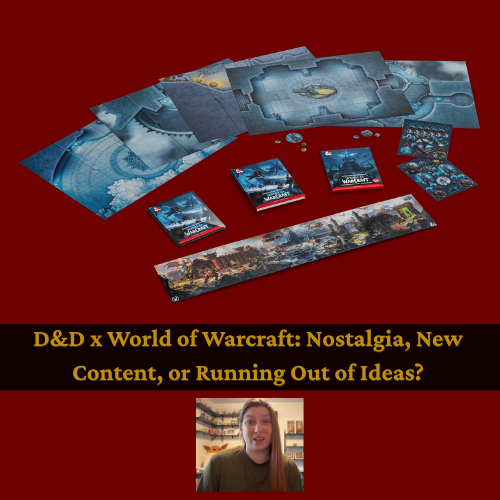
Transcribed content from our recent YouTube video: https://www.youtube.com/watch?v=hMFP7UHtWEU Transcription [00:00:00] Welcome back to Eternity TTRPG, where we go over different happenings in the TTRPG universe, as well as talk about the game that we have been creating. Um, this go around, I think all of the hype is around, um, D&D World of Warcraft. Um, the Dungeon Masters, like, YouTube channel decided to go ahead and start a new campaign all around the World of Warcraft stuff, um, using all of those materials, even though it doesn't release until, like, mid-November. Um, so there's a lot of talk about everything that they're doing and what's going on. So I thought I'd give a little rundown of what to expect with the World of Warcraft expan- or excuse me, World of Warcraft, like, collaboration that's going on, right? So there was a lot of speculation when this first came out what it would be over. Like, is it gonna be one of the classic expansions like Burning [00:01:00] Crusade or Pandaria and just pull from one of those? Do we get any of the classic dungeons like Deadmines or Deepfathom? Um, and also what classes are they gonna bring to the table? What about subclasses and all of that kind of stuff? So I'm just gonna go over what we kind of know, um, and I think that's all that's been revealed. So with that in mind, you have, um- 13 World of Warcraft classes, um, along with they are featuring nine new and revised subclasses, and there's over 40 different specializations. So classic, um, classes that you're gonna be seeing from World of Warcraft is gonna be like Death Knight, Demon Hunter, your Druid, Mage, Priest, Monk, Warrior, Paladin. Um, they are doing the Evoker, which I think is relatively new compared to where the setting is of the, um, [00:02:00] guidebook that they're coming out with. Um, the book itself that they're coming out with, of course, has-- It does have your classic dungeons like Deadmines, and Deepfathom, and, um, Scarlet Monastery, uh, along with like Dire Maul and Shadowfang Keep. Um, so I think that's really neat that they're actually gonna do some of those, um, instances which I have fond memories of Deadmines especially 'cause, you know, that was just-- it was a classic. And they ended up coming back and remaking it for higher level which was really neat too to get more of the storyline there. Um, and then along with all of this there is like 50 monsters and 30 dungeon bosses that they give stats for in the guidebook which I think is neat because you're not gonna run out of monsters really easily with that. Um, I just hope that they reign true to like the [00:03:00] monsters that you would face and the different characters you would face in World of Warcraft like I think of the kobolds, um, in Elwynn Forest and how if you didn't, you know, prepare correctly you were gone pretty quick, right? Um, so I thought that was really neat. Um, I also think that they're reigning true to a lot of the professions and spells and magic items, um, such as Moonfire which I remember fondly from druids. Um, and then of course you have stuff like mounts and companion creatures that I think they're gonna bring into play as well, 'cause I of course remember like, oh gosh, you know, the classic horses that you see for any human. Um, and I specifically remember paladins riding them, so that was just in my mind. Um- Let's see what else we have. Oh, so subclasses that I found was gonna be like the Swashbuckler Rogue, the [00:04:00] Path of the Spiritual Guardian, and the Warrior of Mystic Brews. Which, why did that become the joke with your pandas in World of Warcraft? Why did they become the drunks? I never understood that. I still think it was a really cool touch, but now when I think of like pandas, and even Kung Fu Panda, for crying out loud, I just think of Po as like this drunk panda. Um, so I... Why did that become the thing? Yeah, um, with that all... Let's see. As far as what you can get, like D&D has this ultimate bundle going on where you get the whole like guidebook with all of the, you know, monsters, instances, potions, all that stuff. They also have like a map pack for the Icecrown Citadel, which you actually find in Northrend. [00:05:00] Um, so I think that's kind of neat. Um, and then they of course have the dungeon master screen. They have k- they have, um, the digital stuff to go all with it. Then they're doing like a promo with murloc minis. Which those murlocs, you know they're gonna have those as monsters, and you know they're gonna be mean and annoying, and they're gonna end up, you know, taking over your party pretty easily, 'cause that's what they did in the original World of Warcraft. And I had many bad experiences with murlocs, so when I hear that noise, I just, I, ew, you know, don't like it. Let's see. You know, it's just... When we think about this, right, I am so happy to see, like, us doing some world crossovers, uh, Dungeons and Dragons wanting to pull in more people. And when I [00:06:00] think of tabletop role play, my first thought actually does go to World of Warcraft, because that was like my first experience with playing a different character and having magical powers and having these different things to face and fight. So it's very nostalgic for me and, you know, in a way I kinda just want to get it for the nostalgia. Um, but the other side of this is like, is Dungeons and Dragons running out of ideas because they have to pull from existing universes? Or are they just doing what we already do when we make a campaign? You know, as a campaign, I think we pull f- As a dungeon master, campaign writer, all that kind of stuff, I feel like we pull from different things that we already see in the world around us. Um, for example, there was an anime, I'm trying to remember the name of [00:07:00] it. Um, but basically they got stuck in this video game, and you had to complete one level after another, and once you reached like level 100, you could finally leave the video game. Um, so I think we went ahead and pulled an idea of that, and like we would keep going back to this location. Every time we went to this location, it would be a different like level in it that we would ascend to. Um, sadly, that campaign never finished, but it's just another example of like we pull from the things that we enjoy, right? So if I enjoy from World of Warcraft, I'm gonna already pull ideas from that without needing the Dungeon Master Guide or needing D&D to do any kind of crossover. Um, but you know, they're bringing in two different names, um, for themselves between Dun- Dungeons & Dragons, World of Warcraft, bringing in two different audiences and, you know, bringing in new revenue for them, right? So, you know, I, I don't know. I think it's gonna be neat. I really like that they [00:08:00] wanted to do this kind of thing. But I mean, we already do that as people that make their campaigns as dungeon masters. So at what point are we really doing something new? I don't know. Leave your thoughts down below. Comment, like, subscribe, do all the stuff, and we'll catch y'all next time.